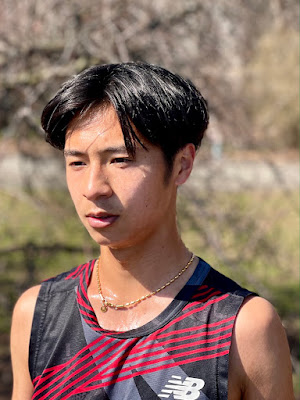
Long Time Coming - Akira Akasaki and Haruka Onodera's Road to the 2022 United Airlines NYC Half


Back in pre-pandemic days Akira Akasaki and Haruka Onodera were still in college, Akasaki at Takushoku University and Onodera at Teikyo University. At the 2019 Ageo City Half Marathon they frontran most of the race together, dead set on finishing in the top two Japanese collegiate spots to win invitations to the 2020 United Airlines NYC Half. For Akasaki it had already been a year and a half wait.


Inspired by Kenta Murayama's 1:00:57 5th place in finish in New York in 2017 and Kei Katanishi's 7th-place in 2018, Akasaki went for it his junior year in his debut at the 2018 Ageo Half. "Coming up to 10 km I was in the lead pack and feeling good, so I knew I had a shot at going to New York and got pretty excited," he said. But right after the 10 km turnaround point he tripped and fell, and by the time he was back up the lead group was out of range. He finished 20th in 1:03:07, over a minute and a half behind top Japanese university man Ken Nakayama.

"I was furious with myself and totally disappointed," he said. Apart from the Hakone Ekiden, Akasaki made taking the spot at the next Ageo the main focus of his senior year, and it showed. At Ageo 2019 he ran a PB of 1:01:46 to score a place in New York for the next spring. Onodera was next in a 1:02:03 PB to pick up the second invitation. In the nine years that the New York Road Runners had been bringing Japanese collegiate runners to the NYC Half, they were the first ones from their schools to make the cut, and for both of them it was going to be their first time ever being outside Japan.
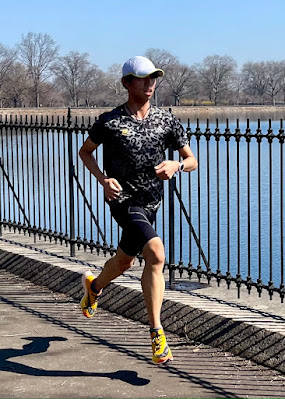
But, history intervened. As the pandemic progressed and races started to cancel, first in Asia, then elsewhere, I was in touch with their coaches Takuro Yamashita and Takayuki Nakano daily. We came to the agreement that if the 2020 NYC Half went ahead Akasaki and Onodera should be in it, and that if it hadn't been canceled by the time our flight left Japan the Wednesday before the race then we'd go. Three hours before we were supposed to leave for the airport I got the call from the NYRR's Sam Grotewold that it was off. "It was a huge shock," said Onodera. "Coach and I were all packed and ready to go."

Fast forward two years. David Monti, who I'd first talked to about the idea of bringing top Japanese university men to the NYC Half, left his position as pro athletes consultant with the NYRR. Both Akasaki and Onodera graduated, Akasaki going to the Kyudenko corporate team back home in Fukuoka, and Onodera to Toyota Boshoku near Nagoya. Onodera had a hard time adapting to the higher training load and was injured most of his first year in the corporate leagues, but at February's National Corporate Half Marathon he made a comeback with a 1:02:21, not far off his best at Ageo. Akasaki made a very early marathon debut in February at Beppu-Oita, running to win but fading late to finish 7th in 2:09:17, a minute and a half behind winner Yusuke Nishiyama, another NYC Half alum making his own debut.
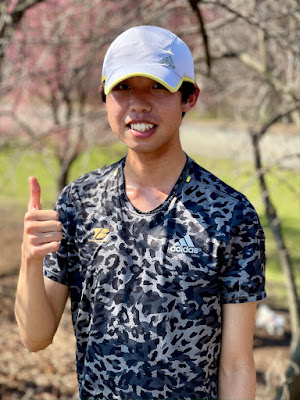
And Ageo hasn't been held since they ran it. Neither had NYC. Last fall when Grotewold told me that the plan was for the NYC Half to happen again in 2022 we both agreed that we wanted Akasaki and Onodera there, and with the help of coaches Yamashita and Nakano both corporate teams were open to it happening. The guys themselves were over the moon. "I've regretted not being able to go the whole time since then," said Akasaki. "I thought I'd missed the chance, and I can't believe it's really here now." "I'm really excited to finally get the chance to run overseas," agreed Onodera.

Schedule conflicts and lingering pandemic concerns kept Yamashita and Nakano from coming with them, Akasaki traveling on his own and Onodera with Toyota Boshoku team manager Ryota Tajiri. "That's my only regret now," said Akasaki. "Coach Yamashita really helped me grow and I wanted to pay him back by bringing him to New York. All I can do now is run a race that'll make him proud."

The field at the United Airlines NYC Half this year is the best since the first time we brought collegiate runners in 2012, when future half marathon and marathon national breaker Yuta Shitara ran the fastest time ever at that point by a Japanese man on U.S. soil, 1:01:47. Asked who they're most excited about racing, both Onodera and Akasaki immediately answered, "Galen Rupp." Even though they're not in college any more there's no change in expectations or the original concept behind them being there. Take some of Japan's best young talent out of the closed-off box they're kept in, drop them into the middle of some of the world's best in a totally unfamiliar environment, and let 'em take a swing.

Shitara went on from that experience to break the national record in the half marathon and marathon, Nishiyama won one of Japan's most important marathons this season, and a lot of the other program alum have gone on to success of their own. Three years is a long time to wait, four, even, in Akasaki's case, but both of them finally get their chance this Sunday to do what their younger selves had dreamed of. Whatever happens, it'll be something they can take back with them to help illuminate their corner of the box just like Shitara and the others since him have.


text and photos © 2022 Brett Larner, all rights reserved

Buy Me A Coffee

Comments

Rigajags said…
Thats a nice story, i hope they do well and have a great time!

Most-Read This Week

Murayama and Sasaki Making U.S. Debut at New York Mini 10 km

Every year since 2012 that there's been a United Airlines NYC Half , JRN has partnered with the NYRR and November's Ageo City Half Marathon to bring two top-tier collegiate Japanese men to the NYC Half for what's usually been their international debuts. For years we've wanted to extend that program to include top collegiate women, but that has always faced 2 problems. For one, while the half marathon distance is the main focus for Japanese collegiate men due to the stage lengths at the Hakone Ekiden, few collegiate women run it. Those that do run the National University Women's Half Marathon in Matsue, held the same day as the NYC Half. This year, though, we're finally making it happen in a slightly different way. Amisa Murayama and Nazuki Sasaki of 2025 Mt. Fuji Women's Ekiden national collegiate championship runner-up Tohoku Fukushi University are joining the field for the NYRR's Mastercard New York Mini 10 km on June 6. After running an 18:14 CR ...

Australian YouTuber Handed Lifetime Ban by Ageo City Half Marathon After Running 1:06 with Another Runner's Bib (updated)

After discussion with their race's chief JAAF referee, on Nov. 27 the organizers of the Ageo City Half Marathon handed down a lifetime ban from their event against 36-year-old Australian Matt Inglis Fox  for running the Nov. 15 race wearing the bib number of another JAAF-registered runner. The incident came to light after Fox posted on his personal Instagram account that he had run a PB of 1:06:33 and finished 203rd in Ageo with a 10 km split of 31:03, along with photos and video of himself in the race wearing a bib number beginning with 11. Fox did not appear in the results by name or in that time or place, the closest match being a 1:06:54 gross, 1:06:50 net finish time with a 31:21 10 km split for 18th place in the JAAF-registered division and 209th overall by bib number 1129, registered to a non-Japanese Tokyo-resident club runner. The club runner, Harrisson Uk , readily confirmed that he had given his bib to Fox, saying, "I gave my number to Matt. It wasn't me."...

Some Reflections on the Ekiden

by Brett Larner This ekiden season I've had a few thoughts kicking around, and watching this week's Hakone Ekiden a few of them became clearer.  These are still in progress, but at the moment this is what I'm thinking in terms of running as a spectator sport and about the quality of Japanese men's distance running right now. Quality: Japanese men's running is coming up very, very quickly.  I was in the lead car at November's Ageo City Half Marathon , where 18 men, 17 of them university runners, broke 63 minutes.  As it was going on we all thought it was a slow race because there were so many people running that pace all the way, no separation at all in the mass of the pack. See the JRN header photo above, taken just past halfway.  That's pretty unusual in Japan, especially at the university level; generally you'll get a handful of guys who run an aggressive pace and a mass running dead on a safe pace, 3:00/km in a half marathon, for example. Th...