
Relance was launched in late 2019 by designer Violaine Grégoire. The RL-01 is the first shoe she and her team have brought to market. Still in the Kickstarter phase, Relance hopes that the RL-01's limited release will help generate the funds and interest needed to launch full-scale production and additional models next year.
The Shoe
At first glance the RL-01 looks like what it is, a heavy cushioned trainer geared toward fashion-conscious recreational runners. It's got a lot of nice styling details like a blue-white-red tricolour logo and heel loop, and a single pair of differently-colored eyelets, but weighing in at 330 g it's definitely on the heavier end of the spectrum. PR materials claimed a 10 mm drop on the shoe, which seemed accurate.

The Upper
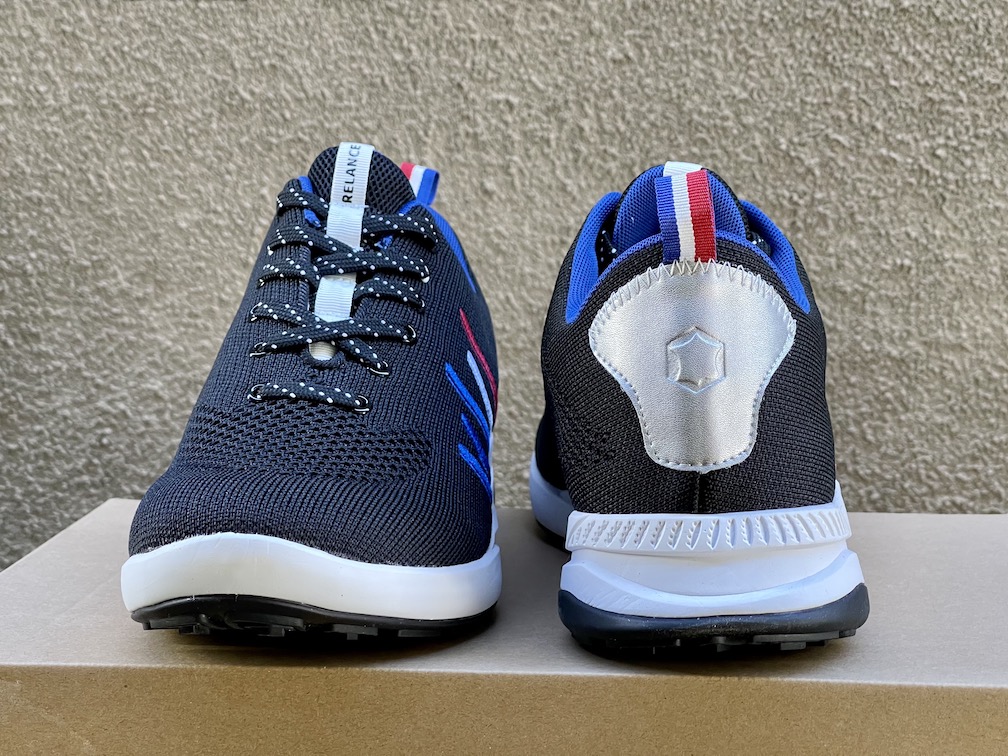
The upper is a thick knit mesh that the company's site describes as minimizing wasted material during the manufacturing process, with only a single seam on the outside rear of the heel. Everything behind the arch of the foot is enclosed in a rigid heel cup with a thick ankle cuff. Despite what seemed like minimal ventilation, even though I did all the test runs on the shoe in the middle of the heat and humidity of a Tokyo August, the RL-01 never felt too hot or lacking in breathability.
One thing I didn't like was a seam running down both sides of the inside liner just ahead of the arch end of the heel cup. There was a loose forward-facing flap of material just ahead of where the seam was stitched that seemed like it would have the potential for irritation on longer runs. I felt like these could easily be stitched better to eliminate the flap of extra material.
A white strip down the middle of the tongue kept the laces in place and prevented any tongue slippage. The outside of the heel featured the only reflective material on the shoe, a stitched-on faux leather silver wedge. Rather than high-visibility it is simply shiny, and while it looks good it seemed like unnecessary weight and unbreathable material that could be replaced with lighter, higher-visibility material.
The Midsole
The midsole is a single layer of curved foam about 15 mm thick under the ball of the foot and 24 mm under the heel, extending back an extra 5 mm behind the vertical line of the heel. No details on the material were available, but it had a good feel. For reference, the last few months I've been running in the On Cloudflyer, Karhu Fusion 2021 and Mizuno Wave Rider 24. I'd categorize the Cloudflyer as hard, the Fusion as firm (i.e. hard but some responsiveness) and the Wave Rider soft. The RL-01's midsole is on the responsive side of firm relative to the Fusion. On both the inside and outside of the arch it's thicker, but under the foot it's the same level as in the forefoot and heel, meaning there's a saddleback that offers some stability without higher-density foam or other mechanisms.

The Outsole
The outsole is a bit of throwback by today's standards, a single layer of thick, hard polyurethane that leaves none of the midsole material exposed to the pavement. About 3 mm thick along most of the shoe, in the heel it's about 14 mm at its thickest point on both the inside and outside of the heel. The forefoot and heel feature a tread pattern of protruding triangles and wedges that reminded me of Newton's technology as they seemed to take the initial impact with the road surface and to compress a little before the rest of the sole made contact.
 The Insole

When I pulled it out he insole was one of the bigger surprises and seemed to have the highest level of engineering in the shoe. Made up of four different densities of foam, it looks more like an insole you might buy separately rather than what you'd usually expect to come pre-installed.


First Feel
On first feel on the foot, the RL-01 was very roomy but surprisingly comfortable. Even just standing the drop was noticeable. The sizing on the box was what I usually wear, but it felt like I could have gone at least a half size smaller, maybe a full size. On the first two runs I had to tie it much tighter than I usually would in order to feel like it wasn't sliding around, which created some discomfort on the front of the ankle. From the third run on I switched to thicker socks, which made the fit feel pretty much right through the heel and ankle, but still left the toe box feeling too big. The shoe being a little too big probably contributed to it feeling well-ventilated and may have prevented irritation by the loose seams mentioned above.
The Run
I did about 50 km in the RL-01 prior to this review, 40 km on pavement and 10 km on soft surfaces, ranging from about 4:00/km to 6:30/km with a longest run of 16 km. From the first run they felt lighter than their 330 g weight, especially in comparison to comparable cushioned trainer models from other makers. Once I got the sock and lace tightness worked out to compensate for the shoes being a bit too big they handled well and were notably stable on sharp corners. Even on the longest run the sense of them being lighter than they were held up.
The interaction between the midsole and insole was a lot more pronounced than in other shoes I've run in in recent years, the midsole firm but responsive as above and the insole adding a noticeable layer of cushioning and return. At slower paces the heel unit felt well-designed to accommodate heel striking, in particular the extra-thick oval in the insole. I was concerned that the edge of the oval would be irritating as that part of the foot doesn't usually come into contact with a seam or edge, but I never actually felt it.

The similar elevated pad on the top of the forefoot was noticeable, though, and its leading edge came right where the pad of the big toe starts to curve toward the joint. It might have been a product of the shoe being a half size too big, but the placement was a constant irritation on the first few runs; not enough to rub and cause blisters but an odd sensation where you wouldn't normally have one. Once I switched to thicker socks it wasn't noticeable any more.
The faster-paced runs were probably the biggest surprise, as the responsiveness of the midsole foam made for surprisingly comfortable forefoot running. My sense is that the high construction of the arch in the midsole and insole encouraged this. At moderate and slower paces the thickness and rigidity of the arch was prominent and could be another source of irritation for anyone with a relatively low arch or flat foot, but at higher paces it seemed to encourage the foot to roll a little further forward. Summer in Tokyo and where I am in my fitness right now precluded doing anything faster or longer within the window I had, but while the shoe is clearly not intended for speedwork I'd like to try it out on something more in the 3:30/km range. Likewise for a 30 km long run.
I also didn't have the chance to try the RL-01 on wet pavement, but the tread's grip on both dry pavement and dirt trails seemed good and I wouldn't expect slipperiness to be an issue.

Quality
After 50 km the hard polyurethane outsole showed no sign of wear or abrasion. The only clear sign of any wear was the hexagonal Relance logo printed on the heel of the insole being partially worn off on one foot. It seemed like the adhesive between the heel cup and inner liner may have started to come unstuck after 50 km, but I didn't notice its initial state so I'm not sure how much it may have changed, and in case it wasn't noticeable unless you examined it very closely and not at all while running.
Overall
For a first-time product from a company that has been in existence for less than two years the RL-01 is a good debut. I can certainly think of a few makers that took a lot longer to reach a comparable level. It's not perfect, and in its current form might be best for the curious and people who like to have the newest whatever. But it shows potential, and if Relance's Kickstarter campaign, which offers backers the chance to try the RL-01 at a pre-market price, is successful there'll hopefully be an updated model with the kinks ironed out on the way next year. There's no indication of plans for a performance model, but one step at a time.

text and photos © 2021 Brett Larner, all rights reserved

Comments