by Brett Larner
photo credits at bottom
click here for race highlights video courtesy of broadcaster KBC

Former world record holder Patrick Makau (Kenya) ran what he needed to score the win in his return to the marathon today in Fukuoka, sitting back in the pack throughout the race before dropping the competition in the last 4 km to win in 2:08:22. But the star of the show did not hail from Kenya, or Africa, or Japan.
At the pre-race press conference the top group of contenders were asked what percent confidence they had that they could win. Favorite Makau said 90%. 2012 Fukuoka winner Joseph Gitau (Kenya/Team JFE Steel) replied 82%. Last year's winner Martin Mathathi (Kenya/Suzuki Hamamatsu AC) said 50%, a suggestion of things to come. Japanese top two Kentaro Nakamoto (Team Yasukawa Denki) and Masakazu Fujiwara (Team Honda) gave only 50% and 20% estimates. Ser-Od Bat-Ochir (Mongolia/Team NTN), who beat Yuki Kawauchi (Saitama Pref. Gov't) at last December's Hofu Yomiuri Marathon in a Mongolian national record 2:09:00, answered 100%.
 Things started slow, with an opening 5 km of only 15:16. Around 30 runners made up the large lead pack as the pace picked up, the next 5 km passing in 15:04 followed by a quick 14:57. Ideal conditions around 8 degrees, 52% humidity, partially cloudy skies and virtually no wind meant everyone looked comfortable, and an accident had to happen for one of the favorites to crack. Looking good at the pace, 2005 Fukuoka winner Dymtro Baranovskyy (Ukraine) fell hard at the 15 km drink table and could not get up. The incident shook the pack up, and stragglers began to slip off the back.
 A 15:00 split took the lead group through 20 km and on to 1:03:37 at halfway, where like last year the pacers stepped off the course. Halfway seems a strange place to cut the pacing, and predictably the pace immediately dropped to the slowest 5 km split so far in the race, 15:21. There was almost constant turnover up front as the tension built and people got nervous waiting for someone to make a real move. It took Bat-Ochir's 100% dedication to the win for that to happen.
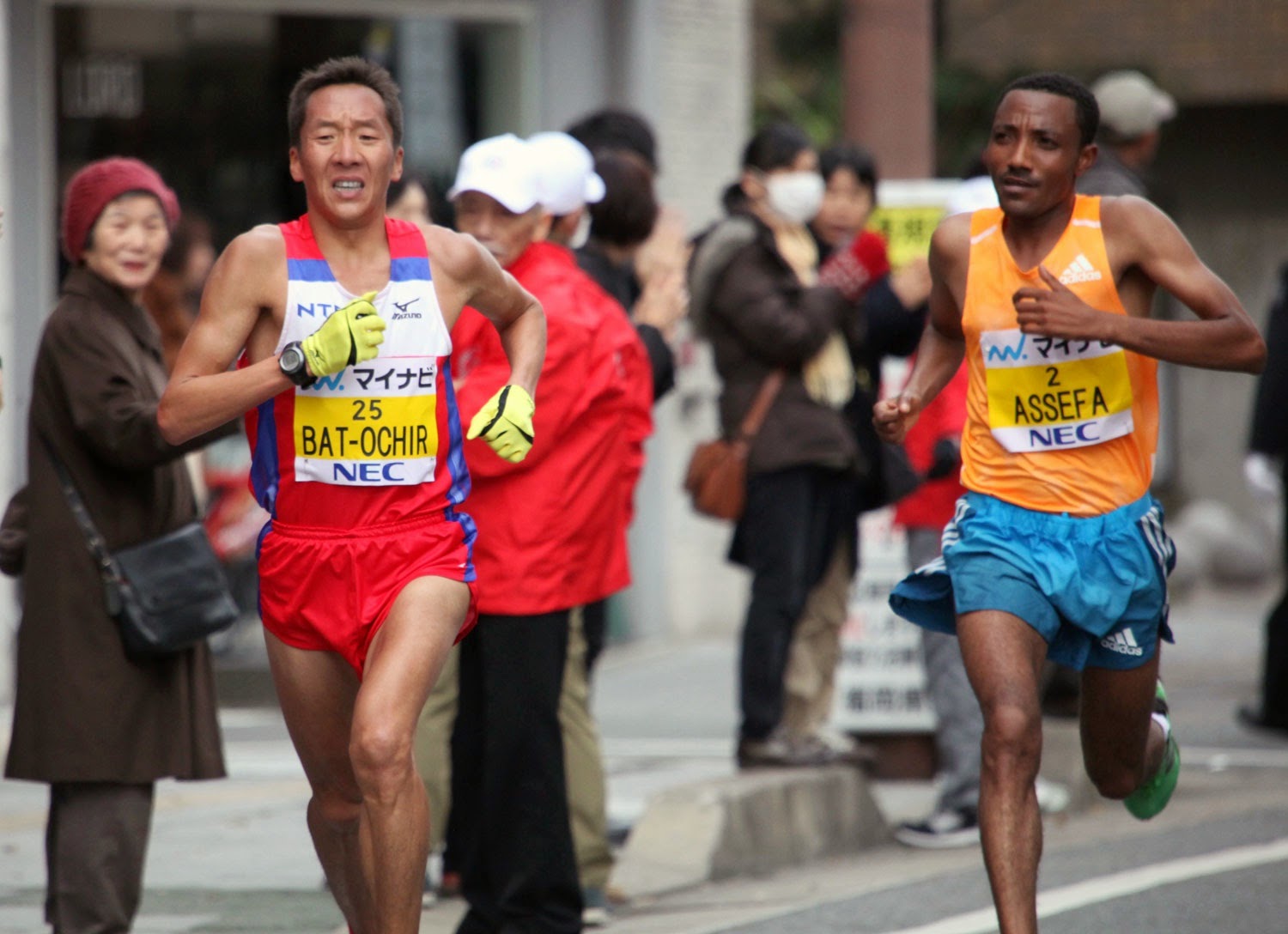 Approaching the turnaround near 28 km Bat-Ochir threw down a surge that at first only Eritrean national record holder Yared Asmerom followed. But as Bat-Ochir continued to pull away and Asmerom let go and came back Makau took note and took off in pursuit with 2:06 Ethiopian Raji Assefa in tow. The move shattered the pack, with a chase group including Polish national record holder Henryk Szost, former Hakone Ekiden superstar Mekubo Mogusu (Kenya/Team Nissin Shokuhin), Johana Maina (Kenya/Team Fujitsu) and Japanese athletes Fujiwara, Nakamoto, Chiharu Takada (Team JR Higashi Nihon), Tsuyoshi Ugachi (Team Konica Minolta) and Tomoya Adachi (Team Asahi Kasei) congealing in sight of the breakaway trio.
As Makau and Assefa caught Bat-Ochir, Fujiwara, the Japanese debut and collegiate marathon record holder at 2:08:12 and the only Japanese man ever to win the Tokyo Marathon, picked it up to try to close the gap to the leaders. Although he dropped the rest of the chase group and inched forward from 13 seconds back to 10 he remained stuck in limbo alone as the race up front got rolling.
 Bat-Ochir surged hard. Makau and Assefa closed. Bat-Ochir surged again at 35 km, and again they came back. At 37 km he made what was clearly his big play, steadily opening a gap before Makau had enough and went after him for real. At 38 km Makau went by, and it was all over up front as he sailed on to the win in 2:08:22.
 Assefa struggled to catch Bat-Ochir, but when he did they traded places repeatedly over the last 3 km before Assefa kicked away to 2nd in 2:08:48. Bat-Ochir took 3rd in 2:08:50, a ten second PB over his winning time in Hofu last year and another Mongolian national record. Hired by the NTN corporate team earlier this year to support his marathoning and serve as incentive to Japan's marathoners, he paid that investment back in full.
 Fujiwara, in pursuit of a PB, struggled to keep the pace running alone and slowed, finishing 4th in 2:09:06. With the Federation's sub-2:06:30 requirement for automatic qualification for the 2015 Beijing World Championships team essentially meaning that, in keeping with the spirit of Japan's current political leadership, they are saying they will choose the team behind closed doors based on whatever factors they see fit without having to be held accountable to any clear-cut public standards, two-time World Championships team member Fujiwara has to wait until after March's Lake Biwa Mainichi Marathon to know whether he has been deemed worthy of a third time on the team.
Behind him, Maina, Mogusu, Nakamoto and Ugachi fell off the pack, leaving Adachi, Szost, Takada and Asmerom to sprint it out on the track in hopes of hitting sub-2:10. Adachi, who won the 2008 Beppu-Oita Mainichi Marathon in 2:11:59 in his debut and has seen incremental improvement since then to 2:10:22 at Lake Biwa last year, just made it in 2:09:59. Post-race he said that he had thought about retiring if he blew going sub-2:10 again, but in getting there he became Japan's tenth man under 2:10 this year, a feat only Kenya and Ethiopia have also achieved.
Szost and Takada just missed the mark in 2:10:02 and 2:10:03. Ugachi was next in 2:10:50, a PB that built on his 2:13:41 debut in Dubai last January and 2:12:18 PB in Sydney in September but still came up short of the promise of his 1:00:58 half marathon best. Considering that his national champion Konica Minolta teammate Takayuki Matsumiya ran a then-world record 1:28:00 for 30 km but could only get to 2:09:14 for the marathon it remains to be seen whether the KM coaching staff has the know-how to get him there.
Just behind the struggling Mogusu, unknown Yoshiki Otsuka (Team Aichi Seiko) ran a quality 2:11:40 PB for 11th, beating London Olympics 6th placer and Moscow World Championships 5th placer Nakamoto who ran 2:11:58 in his first-ever off day in the marathon. 2012 winner Gitau was 16th in 2:15:13, while defending champion Mathathi was 21st in 2:17:23.
 26 men altogether broke 2:20, with amateurs Muga Hamazaki (Kai T&F Assoc.) and Sohei Wada (Tokushima T&F Assoc.) running 2 and 6 minute PBs respectively to take 25th and 26th in 2:19:49 and 2:19:57. Post-race Ekiden News, an independent and innovative online media outlet, tweeted:

68th Fukuoka International Marathon
Fukuoka, 12/7/14
click here for complete results
1. Patrick Makau (Kenya) - 2:08:22
2. Raji Assefa (Ethiopia) - 2:08:48
3. Ser-Od Bat-Ochir (Mongolia) - 2:08:50 - NR
4. Masakazu Fujiwara (Team Honda) - 2:09:06
5. Tomoya Adachi (Team Asahi Kasei) - 2:09:59 - PB
6. Henryk Szost (Poland) - 2:10:02
7. Chiharu Takada (Team JR Higashi Nihon) - 2:10:03 - PB
8. Yared Asmerom (Eritrea) - 2:10:09
9. Tsuyoshi Ugachi (Team Konica Minolta) - 2:10:50 - PB
10. Mekubo Mogusu (Kenya/Team Nissin Shokuhin) - 2:11:29
11. Yoshiki Otsuka (Team Aichi Seiko) - 2:11:40 - PB
12. Kentaro Nakamoto (Team Yasukawa Denki) - 2:11:58
13. Noriaki Takahashi (DeNA RC) - 2:12:00 - PB
14. Sean Quigley (U.S.A.) - 2:13:30 - PB
15. Johana Maina (Kenya/Team Fujitsu) - 2:13:46 - debut
16. Joseph Gitau (Kenya/Team JFE Steel) - 2:15:13
17. Takaaki Koda (Team Asahi Kasei) - 2:16:19
18. Taiga Ito (Suzuki Hamamatsu AC) - 2:16:34
19. Benjamin Ngandu (Kenya/Team Monteroza) - 2:16:42
20. Kenji Higashino (Team Asahi Kasei) - 2:16:50 - PB
21. Martin Mathathi (Kenya/Suzuki Hamamatsu AC) - 2:17:23
22. Gladwin Mzazi (South Africa) - 2:17:43 - debut
23. Sho Matsumoto (Team Nikkei Business) - 2:17:49
24. Hayato Sonoda (Team Kurosaki Harima) - 2:19:35 - debut
25. Muga Hamazaki (Kai T&F Assoc.) - 2:19:49 - PB
26. Sohei Wada (Tokushima T&F Assoc.) - 2:19:57 - PB
-----
37. Yuichiro Ueno (DeNA RC) - 2:22:34 - debut
58. Makoto Fukui (Team Fujitsu) - 2:26:26
-----
DNF - Dmytro Baranovskyy (Ukraine)
DNF - Jeffrey Eggleston (U.S.A.)
DNF - Isaac Macharia (Kenya)
DNF - Cuthbert Nyasango (Zimbabwe)
text (c) 2014 Brett Larner, all rights reserved
Makau finish photo (c) 2014 Kazuyuki Sugimatsu, all rights reserved
amateurs photo (c) 2014 Ekiden News, all rights reserved
other photos (c) 2014 Dr. Helmut Winter, all rights reserved
photo credits at bottom
click here for race highlights video courtesy of broadcaster KBC
Former world record holder Patrick Makau (Kenya) ran what he needed to score the win in his return to the marathon today in Fukuoka, sitting back in the pack throughout the race before dropping the competition in the last 4 km to win in 2:08:22. But the star of the show did not hail from Kenya, or Africa, or Japan.
At the pre-race press conference the top group of contenders were asked what percent confidence they had that they could win. Favorite Makau said 90%. 2012 Fukuoka winner Joseph Gitau (Kenya/Team JFE Steel) replied 82%. Last year's winner Martin Mathathi (Kenya/Suzuki Hamamatsu AC) said 50%, a suggestion of things to come. Japanese top two Kentaro Nakamoto (Team Yasukawa Denki) and Masakazu Fujiwara (Team Honda) gave only 50% and 20% estimates. Ser-Od Bat-Ochir (Mongolia/Team NTN), who beat Yuki Kawauchi (Saitama Pref. Gov't) at last December's Hofu Yomiuri Marathon in a Mongolian national record 2:09:00, answered 100%.
As Makau and Assefa caught Bat-Ochir, Fujiwara, the Japanese debut and collegiate marathon record holder at 2:08:12 and the only Japanese man ever to win the Tokyo Marathon, picked it up to try to close the gap to the leaders. Although he dropped the rest of the chase group and inched forward from 13 seconds back to 10 he remained stuck in limbo alone as the race up front got rolling.
Bat-Ochir surged hard. Makau and Assefa closed. Bat-Ochir surged again at 35 km, and again they came back. At 37 km he made what was clearly his big play, steadily opening a gap before Makau had enough and went after him for real. At 38 km Makau went by, and it was all over up front as he sailed on to the win in 2:08:22.Behind him, Maina, Mogusu, Nakamoto and Ugachi fell off the pack, leaving Adachi, Szost, Takada and Asmerom to sprint it out on the track in hopes of hitting sub-2:10. Adachi, who won the 2008 Beppu-Oita Mainichi Marathon in 2:11:59 in his debut and has seen incremental improvement since then to 2:10:22 at Lake Biwa last year, just made it in 2:09:59. Post-race he said that he had thought about retiring if he blew going sub-2:10 again, but in getting there he became Japan's tenth man under 2:10 this year, a feat only Kenya and Ethiopia have also achieved.
Szost and Takada just missed the mark in 2:10:02 and 2:10:03. Ugachi was next in 2:10:50, a PB that built on his 2:13:41 debut in Dubai last January and 2:12:18 PB in Sydney in September but still came up short of the promise of his 1:00:58 half marathon best. Considering that his national champion Konica Minolta teammate Takayuki Matsumiya ran a then-world record 1:28:00 for 30 km but could only get to 2:09:14 for the marathon it remains to be seen whether the KM coaching staff has the know-how to get him there.
Just behind the struggling Mogusu, unknown Yoshiki Otsuka (Team Aichi Seiko) ran a quality 2:11:40 PB for 11th, beating London Olympics 6th placer and Moscow World Championships 5th placer Nakamoto who ran 2:11:58 in his first-ever off day in the marathon. 2012 winner Gitau was 16th in 2:15:13, while defending champion Mathathi was 21st in 2:17:23.
Since Fukuoka leads to World Championships and Olympic teams the pro runners get most of the attention, but what really makes it worth watching are the hard-working amateur runners from the B group. There's nothing half-hearted about their shouts of joy when they finish.In a changing environment that sees Japan moving from small, elite races like Fukuoka to embrace a mass-participation format, a move that puts pressure on Fukuoka itself in the form of a new amateur marathon in Fukuoka four weeks earlier that sought to work together with the longstanding elite race but was soundly rejected, those are words worth thinking carefully about.
68th Fukuoka International Marathon
Fukuoka, 12/7/14
click here for complete results
1. Patrick Makau (Kenya) - 2:08:22
2. Raji Assefa (Ethiopia) - 2:08:48
3. Ser-Od Bat-Ochir (Mongolia) - 2:08:50 - NR
4. Masakazu Fujiwara (Team Honda) - 2:09:06
5. Tomoya Adachi (Team Asahi Kasei) - 2:09:59 - PB
6. Henryk Szost (Poland) - 2:10:02
7. Chiharu Takada (Team JR Higashi Nihon) - 2:10:03 - PB
8. Yared Asmerom (Eritrea) - 2:10:09
9. Tsuyoshi Ugachi (Team Konica Minolta) - 2:10:50 - PB
10. Mekubo Mogusu (Kenya/Team Nissin Shokuhin) - 2:11:29
11. Yoshiki Otsuka (Team Aichi Seiko) - 2:11:40 - PB
12. Kentaro Nakamoto (Team Yasukawa Denki) - 2:11:58
13. Noriaki Takahashi (DeNA RC) - 2:12:00 - PB
14. Sean Quigley (U.S.A.) - 2:13:30 - PB
15. Johana Maina (Kenya/Team Fujitsu) - 2:13:46 - debut
16. Joseph Gitau (Kenya/Team JFE Steel) - 2:15:13
17. Takaaki Koda (Team Asahi Kasei) - 2:16:19
18. Taiga Ito (Suzuki Hamamatsu AC) - 2:16:34
19. Benjamin Ngandu (Kenya/Team Monteroza) - 2:16:42
20. Kenji Higashino (Team Asahi Kasei) - 2:16:50 - PB
21. Martin Mathathi (Kenya/Suzuki Hamamatsu AC) - 2:17:23
22. Gladwin Mzazi (South Africa) - 2:17:43 - debut
23. Sho Matsumoto (Team Nikkei Business) - 2:17:49
24. Hayato Sonoda (Team Kurosaki Harima) - 2:19:35 - debut
25. Muga Hamazaki (Kai T&F Assoc.) - 2:19:49 - PB
26. Sohei Wada (Tokushima T&F Assoc.) - 2:19:57 - PB
-----
37. Yuichiro Ueno (DeNA RC) - 2:22:34 - debut
58. Makoto Fukui (Team Fujitsu) - 2:26:26
-----
DNF - Dmytro Baranovskyy (Ukraine)
DNF - Jeffrey Eggleston (U.S.A.)
DNF - Isaac Macharia (Kenya)
DNF - Cuthbert Nyasango (Zimbabwe)
text (c) 2014 Brett Larner, all rights reserved
Makau finish photo (c) 2014 Kazuyuki Sugimatsu, all rights reserved
amateurs photo (c) 2014 Ekiden News, all rights reserved
other photos (c) 2014 Dr. Helmut Winter, all rights reserved
Comments