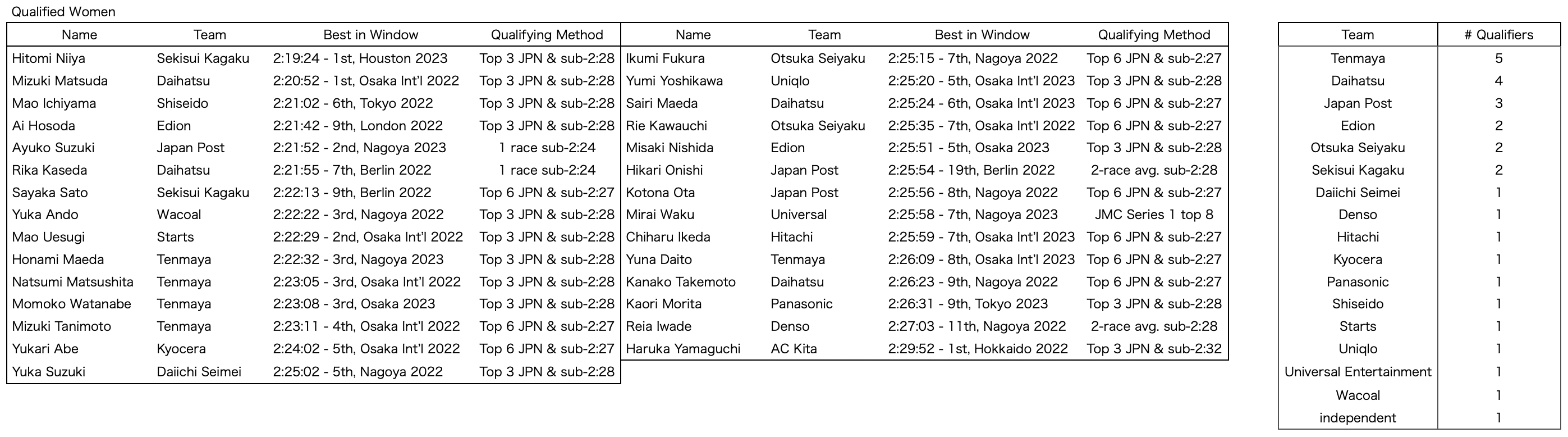
At the MGC Race, the top two finishers will earn guaranteed places on the Paris team. The 3rd placer will have a provisional spot, with the 4th and 5th placers named provisional alternates. If anyone runs under TBA time standards at one of the winter 2023-24 domestic marathons they'll have the chance to steal the 3rd spot on the team from the 3rd placer at the MGC Race, keeping those races relevant and the whole lead-up to the Olympics exciting.
Among women, all three members of the Tokyo Olympics marathon team, Mao Ichiyama (Shiseido), Ayuko Suzuki (Japan Post) and Honami Maeda (Tenmaya) qualified again, along with alternate Mizuki Matsuda (Daihatsu). Yuka Ando (Wacoal), Mizuki Tanimoto (Tenmaya), Sairi Maeda (Daihatsu) and Reia Iwade (Denso) also qualified again, meaning over half the field from last time will be back.

Among men, Suguru Osako (GMO) is the only Tokyo Olympian to make the list again, along with alternate Shohei Otsuka (Kyudenko), NR holder Kengo Suzuki (Fujitsu) and 13 others, making just under half of last time's qualifiers will return.
With both the World Championships and Asian Games happening a short time before the MGC Race and quality teams at both, it's not clear how many of the top people will try to double and how many will give the MGC Race a miss and go for the time standard a few months later. #2-ranked woman Matsuda, #6-ranked Rika Kaseda (Daihatsu) and #7-ranked Sayaka Sato (Sekisui Kagaku), and #2-ranked man Ichitaka Yamashita (Mitsubishi Juko), #3-ranked Kenya Sonota (JR Higashi Nihon) and #5-ranked Kazuya Nishiyama (Toyota) will run Worlds.
The women's team at the Asian Games is weaker with #21-ranked Hikari Onishi (Japan Post) and #23-ranked Mirai Waku (Universal Entertainment) set to run, but the men's team of #6-ranked Yohei Ikeda (Kao) and #9-ranked Toshiki Sadakata (Mitsubishi Juko) is solid. In that sense the MGC process might not produce something close to the best teams Japan could be sending to Paris, but we'll see.
In terms of team representation, as with last time Tenmaya dominates the women's entry list with five entrants. Daihatsu follows with four and Japan Post with three. A total of 16 teams are represented, and one independent athlete, club runner Haruka Yamaguchi (AC Kita), also made the field. 30 men's teams and two independents are represented, with Toyota having seven men on the list even without last time's MGC runner-up Yuma Hattori. Neither JR Higashi Nihon nor Asahi Kasei qualified a single athlete last time, but both have four in the race this time, in Asahi Kasei's case that at least partially due to poaching 2:06 runner Hidekazu Hijikata from Honda. Honda and six other teams all head to the trials with three men each on the list.
The MGC Race happens just 2-3 weeks before the regional qualifying ekidens for the National Corporate Women's Ekiden and New Year Ekiden corporate men's national championships, potentially burning any team with someone qualified. To mitigate that, the Corporate Federation put in place a special rule this year saying that any team that has an athlete in the MGC Race and finishes its regional ekiden will qualify for Nationals without having to make the usual qualifying bracket. That's a saving grace for some of the weaker teams, but in at least one case someone is still getting burned.
Running for the Komori Corporation team, Tsubasa Ichiyama qualified for the MGC Race when he ran 2:07:44 for 3rd and top Japanese at February's Beppu-Oita Mainichi Marathon. He then left Komori at the end of the fiscal year in March to join Sunbelx. Without him, Komori has no qualifiers and will have to make the qualifying bracket at the East Japan corporate ekiden. Sunbelx doesn't have anyone else qualified, and because Ichiyama ran his time before qualifying he won't count in exempting Sunbelx from making the qualifying bracket. This means Sunbelx is the only team that will have to place at its regional qualifier with someone who ran the MGC, putting it at a serious disadvantage in the highly competitive East Japan region. Intricate systems are great, but the more intricate they get the higher the chance is that someone is going to get locked into unintended consequences.

Comments
Only 2 men and 2 women won the marathon they qualified in, and only 7 more men and 6 more women placed on the podium in their qualifying marathon.
I’d bet dollars to donuts that this contributes to the lack of medals at major championships. There’s a similar phenomenon in the US, most notably with the men, where all of the top marathoners are incentivized to run races where most have no real shot at winning or being on the podium. And the sentiment is different than being outright fast enough to medal at those big races. If someone like Suzuki, Yamashita, Sonata, or Osako ran a race a click down from Tokyo where they’d be realistically contending for the win and trying to manage the race as such, that would likely be a necessary stepping stone to figuring out how to medal in championships. Ie, translating their current fitness/ability (2:05) to a medal winning performance. Also, in trying to win a marathon, one often elevates their performance just a bit more than any other scenario, so it could likely translate to even faster performances.
Winning is a skill that’s very different from hanging on as long as you can, and most non-African marathoners on the global stage never practice that skill.
Anyways - just a thought that jumped out looking down the list. Nishiyama and Hoshi might be my pick for darkhorses in the men’s race.
Another part of the problem is that when they run outside one of the big Japanese marathons there's usually almost no serious expectation of performance or concern about the results. It's all for "experience," as if being a sub-2:10 man who gets beaten by the entire women's podium in a Major is something that's going to help you become a successful Olympian.
I think this attitude has been historically fueled in part by the Japanese media, who for decades were the principal sponsors of the big Japanese marathons. It's kind of in their financial interest to talk up the importance of their own domestic races and to make races overseas seem secondary or tertiary. In that regard most Japanese sports journalists are doing advertising work, not journalism. You still see it to some degree, although it can be more subtle now.