
Fukuoka Locals Reflect on Their Marathon's End


The Fukuoka International Marathon came to an end earlier this month on the 5th. A winter tradition that brought the locals famous athletes and legendary drama every year, the race was loved by the average person on the Fukuoka streets. Waves of their applause and cheers filled the ears of the marathoners as they gave it all.

On a bright early winter day athletes sprang to those streets for the last time from historic Heiwaidai Field, the race's start and finish point. Hana Fujito, 15, a 3rd-year junior high school student who came down to cheer excitedly for her running club's coach, said, "A lot of really famous athletes run here. It's cool to get to run in a big race." 

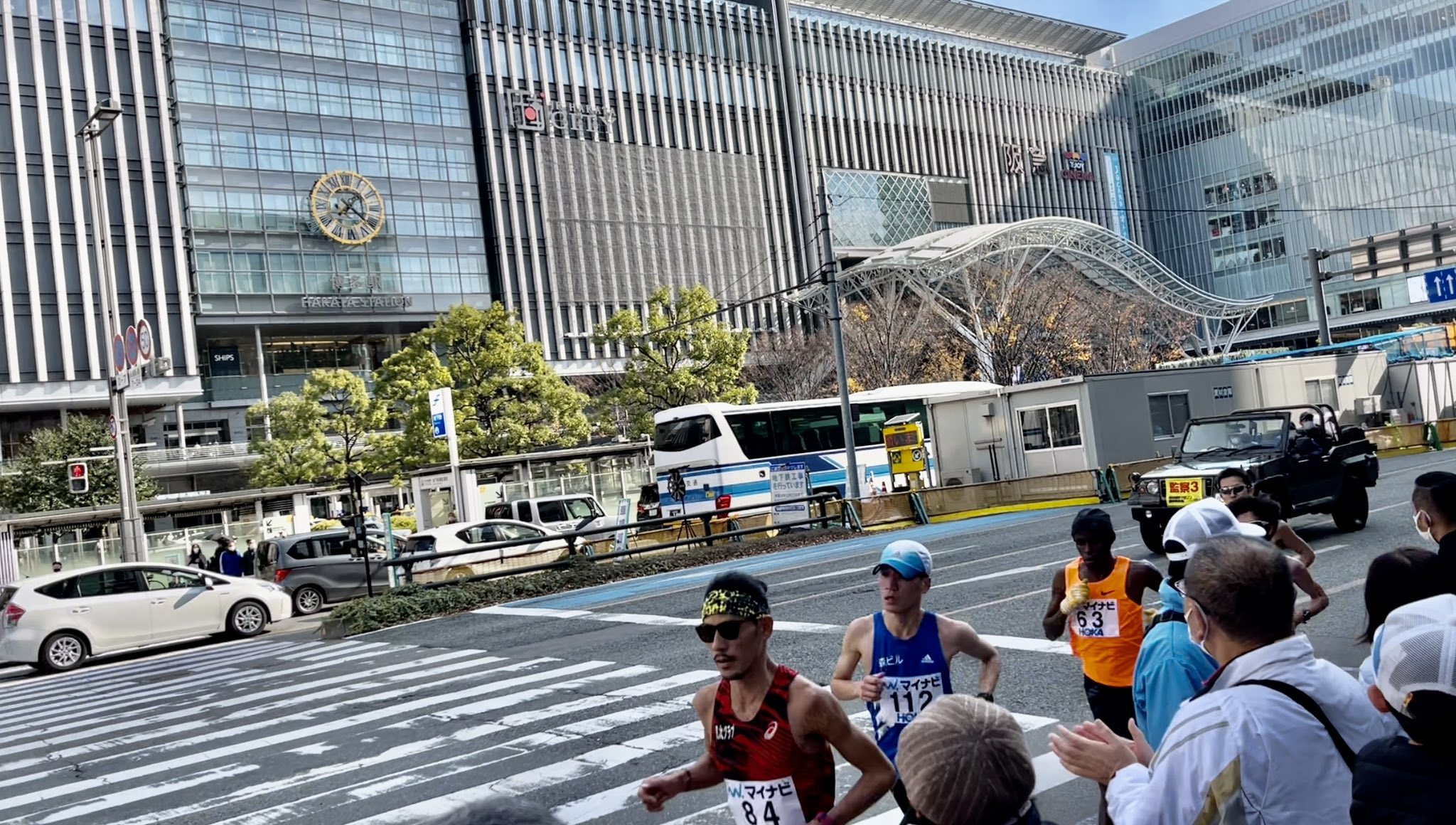
Just past halfway in front of Hakata Station where the race had some dramatic action, the sidewalks were crowded with fans and shoppers. A woman who used to run marathons said, "The course goes near my home, so I've always enjoyed coming to cheer with my daughter. It makes me sad now."


Hideyuki Hashimoto, 62, watched the race near Najima Bridge. He first came to cheer along the course when he was in elementary school. Seeing the motion and hearing the breathing of the athletes from up close he remembers thinking, "Wow!" Now the president of a real estate company, since 1994 he has been cleaning the area around the bridge once a month with other volunteers from the local business association. Every December on marathon day his annual routine has been to clean in the morning and then watch the race. Friends who had moved away from the city would call to say that they had spotted him on the TV broadcast. On the 5th this year, as always, he was out in the early morning to clean the bridge before watching the race from his office. "Seeing the runners gave me motivation," he said. "I'm sorry to see it go, and I want to say thank you."

Wearing the blue uniform jacket of the amateur running club Ohori Runners, club leader Hideo Hashizume, 71, was at Otemon crossing in the race's final kilometer. He is well-known locally for having volunteered for courseside crowd control for over 25 years. Since his club was founded in 1981, members have met early on race morning every year to run the course before the marathon began. Their level was different from that of the athletes in the race, but, he says, "We always ran with the athletes in our hearts." Working courseside security was a special privilege, he says, because you got to feel both the passion of the runners and the enthusiasm of the crowds from close-up. 

What left the deepest impression on Hashizume was the 2000 race, where Atsushi Fujita broke the Japanese national record. "It was thrilling to see how strong he still was even at that point late in the race," he recalls. At the final race, where local Fukuoka athletes finished among the top places, Hashizume once again had his privileged spot along the course. "This race was respected around the world," he said. "It was the pride of Fukuoka, and we loved it."


source article:
translated by Brett Larner

photos © 2021 Brett Larner, all rights reserved

Buy Me A Coffee

Comments

Most-Read This Week

Nagoya Asian Games Test Event Canceled After Insulation Falls From Venue Ceiling

A section of insulation material fell from the ceiling of Nagoya Kinjo Futo Arena, the official venue for squash competition at September's Nagoya Asian Games. There were no injuries, but the city suspended use of the arena until its safety could be guaranteed, resulting in the cancelation of the Asian Games squash test event which was scheduled to have begun on May 14. It is not yet clear whether the arena will be usable for the Asian Games as planned. According to city officials, arena staff found that the insulation material had fallen onto a work walkway 13 m above the ground on the night of May 11. The fallen material was 3.6 m long, 50 cm wide and 2.5 km thick, and was found to be waterlogged. The cause of the accident is unknown, but it is possible that it was caused by rainwater leaking in from the roof. The same insulation material is installed across the entire ceiling, and the city plans to check for the extent of the possible flooding. Asked whether the arena will be re...

Hakone Ekiden Qualifying Race Entry Roster Sizes Increased from 14 to 16

Hakone Ekiden organizers KGRR have announced details for the qualifying half marathon for next year's 103rd Hakone Ekiden. The Yosenkai qualifying race will be held Oct. 17 in Tachikawa, Tokyo. The combined times of the 10 fastest finishers from each participating team will be used for team scoring, with the 10 fastest teams going on the the main event next January and top-placing individuals from teams that do not qualify being names to the Kanto Region Student Alliance select team. One change from previous years is that the number of runners each school can enter has been increased from 14 to 16. Teams will still only be allowed to have from 10 to 12 athletes on the starting line, but the move gives coaches greater flexibility in making the final decision on their starting rosters. No changes have been made to the qualifying times of 34:00 for 10000 m or 1:13:00 for the half marathon, and the new earlier starting time of 8:30 a.m. introduced last year in an effort to mitigate ...

Nomura and Odagiri Go 3-4 at Zevenheuvelenloop 15 km

2010 Zevenheuvelenloop 15 km Nijmegen, Netherlands, 11/21/10 Women click here for complete women's results 1. Genet Getaneh (Ethiopia) - 47:53 2. Florence Kiplagat (Kenya) - 48:07 3. Sayo Nomura (Meijo Univ.) - 49:43 4. Aki Odagiri (Meijo Univ.) - 51:37 5. Benita Willis (Australia) - 51:51 Men click here for complete men's results 1. Leonard Patrick Komon (Kenya) - 41:13 - WR 2. Abera Kuma (Ethiopia) - 42:01 3. Ayele Abshiro (Ethiopia) - 42:01 4. Abraham Kiplimo (Uganda) - 43:03 5. Berhanu Delale (Ethiopia) - 43:08 ----- 14. Kazuya Watanabe (Team Sanyo Tokushu Seiko) - 45:31