
Today was the original date of the 2020 Tokyo Olympics women's marathon, before the coronavirus hit, before the IOC moved the race to Sapporo. Two years ago I went out and did test runs on the course on Aug. 2 and Aug. 9 at the actual times that the women's and men's marathons were to have been run this year, taking temperature and humidity readings every half hour. Last year I did it three times, once on Aug. 2, once on Aug. 5 with European marathon champion Koen Naert of Belgium, and again on Aug. 9, all at the actual race time.
It doesn't really matter any more, but for the sake of completion I decided to do it this year too. If a lot of things had gone differently and the world's marathon women had run the streets of Tokyo today, what kind of conditions would they have ended up actually facing? Only one way to find out.
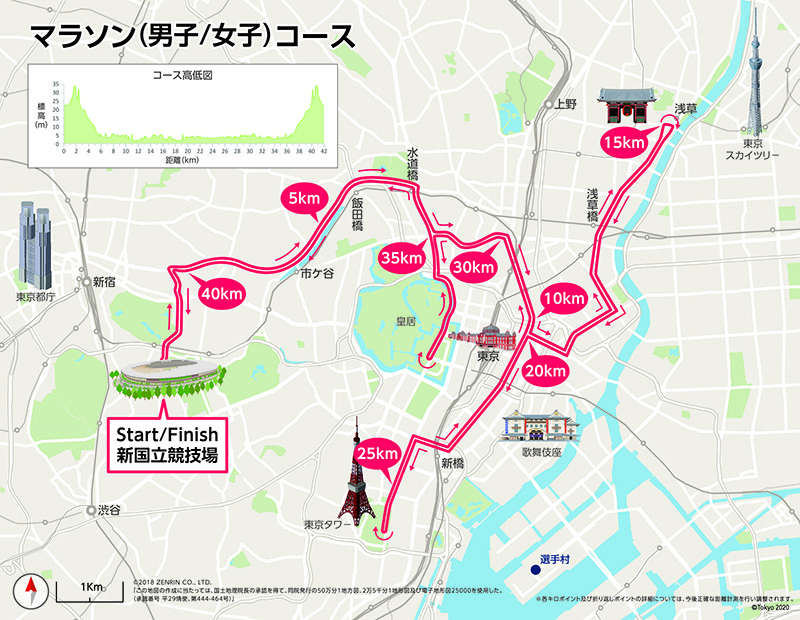
The picture at the top is the view down the marathon gate tunnel into the stadium right at the time the lead women would have been coming out. Like in 2018 and 2019 I started at the Olympic Stadium at the marathon start time and ran the first 20 km of the course. From there I cut off the two north-south out and back sections, which I'll run next week, and followed the course back to the stadium for a total of about 30 km.

The IOC's decision to move the marathons to Sapporo was based on the assumption that conditions there would be significantly better than in Tokyo. The forecast above, Tokyo on the left and Sapporo on the right, didn't predict much difference at race time except for Sapporo being windier, but with the women's race date in Sapporo changed to Aug. 8 we'll have to hold off on that comparison for now.
The rainy season this year was long, only officially ending Aug. 1, and that meant cool temperatures. It was long last year too, ending on July 28, but by five days later conditions had become brutally hot and humid. Given the later end to the rainy season this year that might mean much hotter weather in Sapporo by the 8th. We'll see next weekend.

From start to finish, temperatures were about 5˚C cooler and the humidity 2-3% lower than last year. In addition, there was good cloud cover most of the way and a steady breeze from the north. Humidity was still high, but altogether it felt cool almost the entire way. I only felt like I needed to drink twice during the run, and my pace was about 30 seconds/km faster than last year, even with running with a mask the whole way. The cloud cover started to break up after about two hours, but between shade from buildings and the breeze it wasn't a problem. For a short time about two hours 45 minutes after the start it began to feel hotter, but right after that the cloud cover came back and it cooled off again.

Looking at the heat index, conditions at the start were safe, just ticking over into the "caution" range the rest of the way. Taking the cool breeze from the north into account, most of that time it should have really been in the safe range. By the time it started to feel even the slightest bit hot, 2:45 after the start, most of the field would have been finished. By 3:15 after the start it did get hotter, but by then it's not likely anyone would have been left on the course, and the heat index at that point was still lower than at the start time last year. The conditions were mild enough that I ran the extra 3.5 km home afterward, something I wasn't able to do the other five times.

Altogether, if the Olympic women's marathon had happened today I don't think anyone who had done even the slightest bit of preparation to run in the summer would have had any problems. It was probably on the freakishly cool side and not something you could have anticipated, but anyone who had trained for more normal Tokyo August weather would have been laughing. I know I was. Will Sapporo match this weather after another week of post-rainy season summer heat? We'll see. Either way, I'll be back out one last time next Sunday to run from 20 km to the finish at the time the men's marathon would have happened. See you then.
© 2020 Brett Larner, all rights reserved

Comments