
Today marks one year until the men's marathon at the 2020 Tokyo Olympics. For the third time in the last week, once last Friday with one year to go to the Olympic women's marathon, once on Monday with a likely competitor in the men's marathon, and again today, I ran most of the Olympic marathon course taking temperature and humidity readings every half an hour to get a handle on what kind of conditions athletes in each race can expect to be facing. Between the three runs I covered about 80 km, and including the two times I did it last summer two years out from the women's marathon and men's marathon about 135 km, on the Olympic course. To get it out of the way off the bat, a couple of days ago a few readers told me that the Buy Me A Coffee button wasn't working. I think the problem has been fixed, so if you're so inclined please feel free to use it. Your support for JRN is always really appreciated.
And now on to the run.
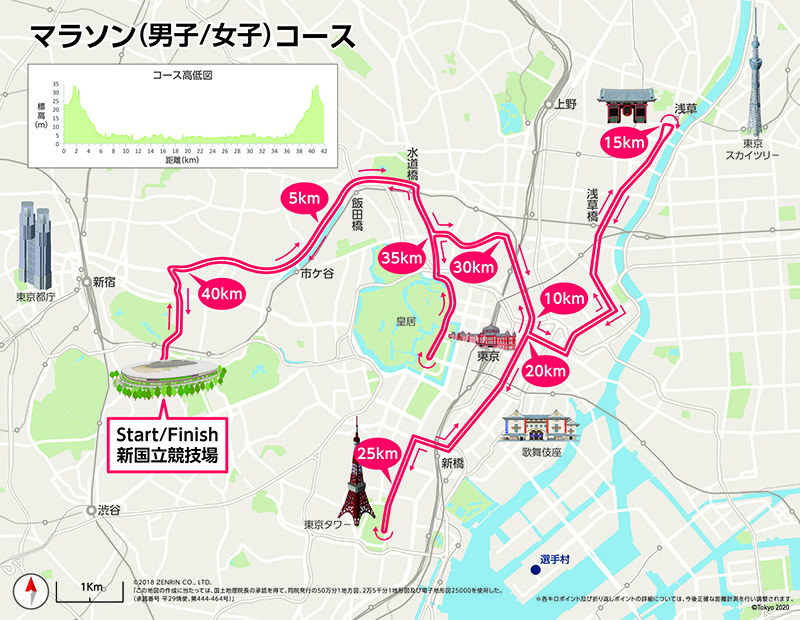
This time out I went to the start point at the Olympic Stadium just before 6:00 a.m. to check the weather conditions, then took the train across to Kanda at about 9 km, ran down to the 20 km point, and from there covered the entire course to the finish before running back home for a total distance of about 23 km on the course and 25 km for the day. At the start I bumped into Japan's first female Olympic marathoner Akemi Masuda, who was doing photos with a camera crew as in the pic at the top. I bumped into her again later just before the 33 km turnaround, where I also saw former 2:08 marathoner Wataru Okutani, now head coach of the Subaru corporate team, with some JAAF officials.
Conditions overall were in between the last two runs, in the same kind of temperature range most of the way and with intermediate humidity. Compared with the other two runs, temperatures were the coolest for the first hour and a half. In particular, since I didn't run the outbound section straight into the sun along Yasukuni Dori between 2 km and 7 km this time the reading for 6:30 a.m. was significantly cooler. On the other hand, the temperatures at 8:30 a.m. and 9:00 a.m. were the hottest of the three runs, an issue for anyone behind the leaders in either race. Humidity stayed relatively constant for the first two to two and a half hours, only falling below 70% after 8:30 a.m. when the medalists are likely to be done.

Skies were cloudless until after 8:30 a.m., and a steady breeze from the south was enough to feel cool, especially in the narrow north-south section through Ginza. The best news of the day was on that 9 km out-and-back section from Nihonbashi through Ginza down to the turnaround at Shiba Park and back, a section I hadn't covered yet on the other two runs this week. Relatively narrow, this part of the course was almost entirely shaded by the buildings on the eastern side of the road, the only exposure to the sun being a few of the broader intersections and the western part of the short east-west bit connecting the street through Ginza and the one down to the turnaround point. Runners shouldn't be exposed to the sun for more than a few seconds at a time, meaning a nice respite from about 20 km to the corner right before 30 km. This pic in Ginza at about 28 km gives you a feel for the contrast.

As with the run on Monday, the turnaround in front of the Imperial Palace at about 33 km was tough, totally exposed to the sun for about the last 500 m before the turnaround and the 500 m or so afterward. Yesterday, one year before the 50 km racewalk, the JAAF took hourly readings of the conditions at this point, recording 34.0˚C and 62% humidity at 7:30 a.m. a little before the lead men would be hitting this part of the marathon course and a killer 37.4˚C and 55% humidity at 8:30 a.m. a bit after the last few women should have gone through. Things were similar today. I didn't take readings at the turnaround, but check the video above to see how long the exposed section is and be careful on it. Even more so for the racewalkers.

The last part of the course along the wide-open Yasukuni Dori toward the final climb back up to the stadium was pretty much the same, with the sun slightly to the left and rear. After 8:00 a.m. the heat index tipped over into the danger range, probably after the male medalists would have finished and around the time that the top women would be in the stadium, but still while a lot of runners male and female would be on that final part of the course. As with the other two runs this week, by 9:00 a.m., three hours after the start, conditions were definitely dangerous. Maybe it's worth looking at them side-by-side.

Both of the runs that were done on the actual days that the marathons will be held next year started in conditions calling for extreme caution. On the first two runs the direct sunlight on the eastbound section from 2 km to 7 km along Yasukuni Dori meant a significantly higher heat index, while this didn't happen at the equivalent time when I skipped that section on the third run. In both of the first two runs as soon as I was past that part of the course the heat index dropped to the same range as on the third day. The upshot is that if it's uncomfortable early on, take heart. It's going to get better once you make the righthand turn in front of Tokyo Dome at 7 km and stay pretty much the same until the lefthand turn just before 30 km.
As all three days had about the same temperatures for the first hour, how quickly the heat index hit a dangerous level correlated with the humidity at the start. When it was about 70% on the second run the heat index didn't register danger until three hours into the race, when just about everyone should be done. When it was around 75% on the third run it hit a dangerous level two and a half hours into the run. When it was around 80% on the first run it got dangerous two hours in. All of these were with temperatures between 28.5˚C and 28.8˚C at the start. Subjectively, the second and third test runs felt doable, but the first one in the high humidity was a slog the entire way.
Things might have been different, but that's the reality of what you're going to be facing if you're running in the Olympic marathons next year. Plan your training accordingly, and on race morning keep a close eye on the conditions as late as you can before the start so you know what it's probably going to be like in the last hour of the race. Good luck, and we'll be cheering for you out there, whoever you are, wherever you're from, and whatever place you come.
© 2019 Brett Larner, all rights reserved

Comments