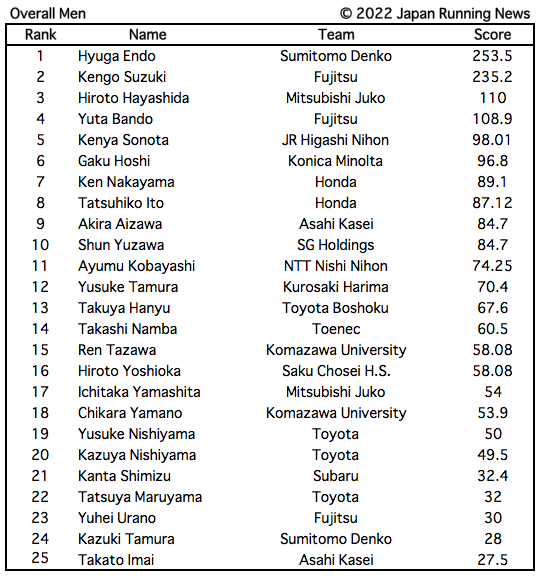
The Japanese women's 2022 season still has big races to come, with the Sanyo Ladies Road Race 10 km and half marathon this weekend and the Nittai University Women's Long Distance Time Trials on Dec. 24, but for men the top lists for the year are pretty much a done deal barring something unexpected at the Dec. 24-25 Heisei Kokusai University Time Trials or Dec. 29 Year End Half Marathon. We'll wait until after Nittai for our women's rankings, but as men from JHS to the corporate leagues do their final preparations for the four championship ekidens over the next three weekends here's how they shaped out in 2022.
Update: Women's rankings are here.
Indoor 5000 m NR holder Hyuga Endo (Sumitomo Denko) took the top spot on the strength of a single run, his all-time JPN #2 13:10.69 win against an incredibly deep field of Japan-based Kenyans at the May 4 Golden Games in Noboeka. That came less than a month after his 3:36.69 1500 m at the Kanakuri Memorial Meet, at the time the 3rd-fastest Japanese mark ever. A 13:22.13 win at June's National Championships was enough to get him to the Oregon World Championships, where he was 13th in his 5000 m heat in 13:47.07. In November Endo broke the little-raced road 5 km NR with a 13:50. A big goal for Endo will be closing the last two seconds on Suguru Osako's 13:08.40 outdoor 5000 m NR before one of the younger guys coming up gets there.
Last year's top man, marathon NR holder Kengo Suzuki (Fujitsu), was 2nd this year, like Endo on the strength of one run. In Suzuki's case that was his 2:05:28 for 4th at March's Tokyo Marathon, the 2nd-fastest time ever by a Japanese man. Corona kept him out of the World Championships marathon, where he very likely would have been in contention for at least bronze, and he hasn't done much else apart from that. But as the only Japanese man under 2:07 this year, and the only one of Japan's ten fastest marathoners of 2021 to make the top ten again this year, what little he managed to do was still more than enough.
Hiroto Hayashida (Mitsubishi Juko) was a distant 3rd in the overall rankings thanks to his photo finish 1:00:38 win at February's National Corporate Half Marathon. A rare top-level Japanese man who bypassed college and the Hakone Ekiden to go straight from high school to the corporate leagues, Hayashida just edged Ken Nakayama (Honda) and Yusuke Tamura (Kurosaki Harima) to get the win, all three of them clocking the same time. With the Mitsubishi Juko corporate team reliably cranking out 2:06 to 2:08 marathoners like Hiroto Inoue and Ichitaka Yamashita, Hayashida's marathon debut will be one of the most anticipated when it happens.
2021 New Year Ekiden top two Fujitsu and Toyota were the only teams at any level to put three men in the overall top 25 rankings, and unsurprisingly, 2022 Izumo Ekiden and National University Ekiden course record breaker Komazawa University was the only college team with two in the top 25, 4th year Ren Tazawa for his 13:22.60 at the Kanaguri Memorial meet, and 4th year Chikara Yamano for his 1:00:40 for 4th at the National Corporate Half, the fastest time ever by a Japanese-born collegiate runner. 18-year-old Hiroto Yoshioka (Saku Chosei H.S.) came in at 16th overall thanks to his 13:22.99 high school NR at Nittai in November, the first time a high schooler has made JRN's overall top 25 for as long as we've been doing the rankings.
Honorable mentions go to two athletes who had stellar performances outside the 5000 m, 10000 m, half marathon and marathon distances. Yamato Yoshii (Chuo Univ.) soloed a fearless 1:00:40 CR on the 21.3 km first leg of the 2022 Hakone Ekiden, equivalent to a 1:00:06 half marathon and 26 seconds under the old CR set by the great Yuki Sato in 2007. One of these days a Japanese man is going to go under 60 minutes for the half marathon, and with this run that set the stage for a record-breaking Hakone, Yoshii showed that he has the ability to be the one to do it. Even if he never gets there, this was the ekiden performance of the year.
Haruki Okayama (Comodi Iida) gets the second honorable mention for his gold medal run at August's IAU 100 km World Championships. Debuting with a world-class 6:16:44 in the spring to make the Japanese national team, Okayama took gold with one of the fastest times ever run, 6:12:10. Geoff Burns, who ran the 100 km WC for the U.S., told JRN post-race, "That 6:12 is one of, if not *the* most impressive road 100km performances. It was a 19.4˚C dew point, which is really hard for running, and nuts for ultra running. Soaking wet from the start to finish and never getting cooler. Those dudes brought it today in a big way." The other dude being Jumpei Yamaguchi (Eldoreso), who also earned a shoutout with a 6:17:19 PB to take silver.

Depth in the four main distances was good. Both the 5000 m and 10000 m were down in depth from 2021's high point, 24 men under 13:33 for 5000 m vs. 28 last year and 21 sub-28 for 10000 m vs. 33 in 2021. But those 2021 numbers were partly a product of limited racing opportunities on the road last year, and the tradeoff was obvious this time around. 15 men cleared 61 minutes for the half marathon this year vs. only one last year, surpassing the pre-pandemic record of 12 in 2020. Suzuki was the only man under 2:07 in the marathon this year vs. 5 in 2021, but 25th-fastest man Yuta Shimoda (GMO) equalled last year's 25th-placer Junichi Tsubouchi (Kurosaki Harima), but having run 2:08:35.
Overall the prospects look good for Japan's ongoing wave of talent to keep rising over the next few years. As always, it's interesting to look at Japanese depth and quality in relation to that in the U.S.A. Compared to Japan's 24 men under 13:33 for 5000 m this year and Endo's 13:10.69 year-leader, the U.S. had 33 men under 13:33 with the top 6 faster than Endo, and one, Grant Fisher, under 13 minutes. Where Japan had 21 men sub-28 for 10000 m led by a 27:27.49 by Takuya Hanyu (Toyota Boshoku), the U.S.A. had 16 under 28. 4 of those were faster than Hanyu, with Fisher again the only one under 27 minutes. Abbabiya Simbassa edged Hayashida by 1 second to lead American half marathon times in 1:00:37, but only 2 Americans were under 61 minutes vs. Japan's 15. The fastest U.S. marathon was Conner Mantz's 2:08:16, a time that 15 Japanese men bettered this year.
Japan's leads in the marathon and half are as big as always, but in the 5000 m and 10000 m things are getting closer than they've ever been. That might change as road racing opens back up, but with the direction things are going right now all that's missing is someone Fisher's level on the track. Whether Yoshioka, triple U20 NR holder Keita Sato (Komazawa University) or someone else from their generation gets there will be one of the big things to watch in Japan over the next 5 years.


Okayama/Yamaguchi photo © 2022 Tarzan Aqzawa/Eldoreso, all rights reserved
text © 2022 Brett Larner, all rights reserved
Comments
Only races from 5000 meters and longer are taken into account i guess? And no ekiden stages are included?