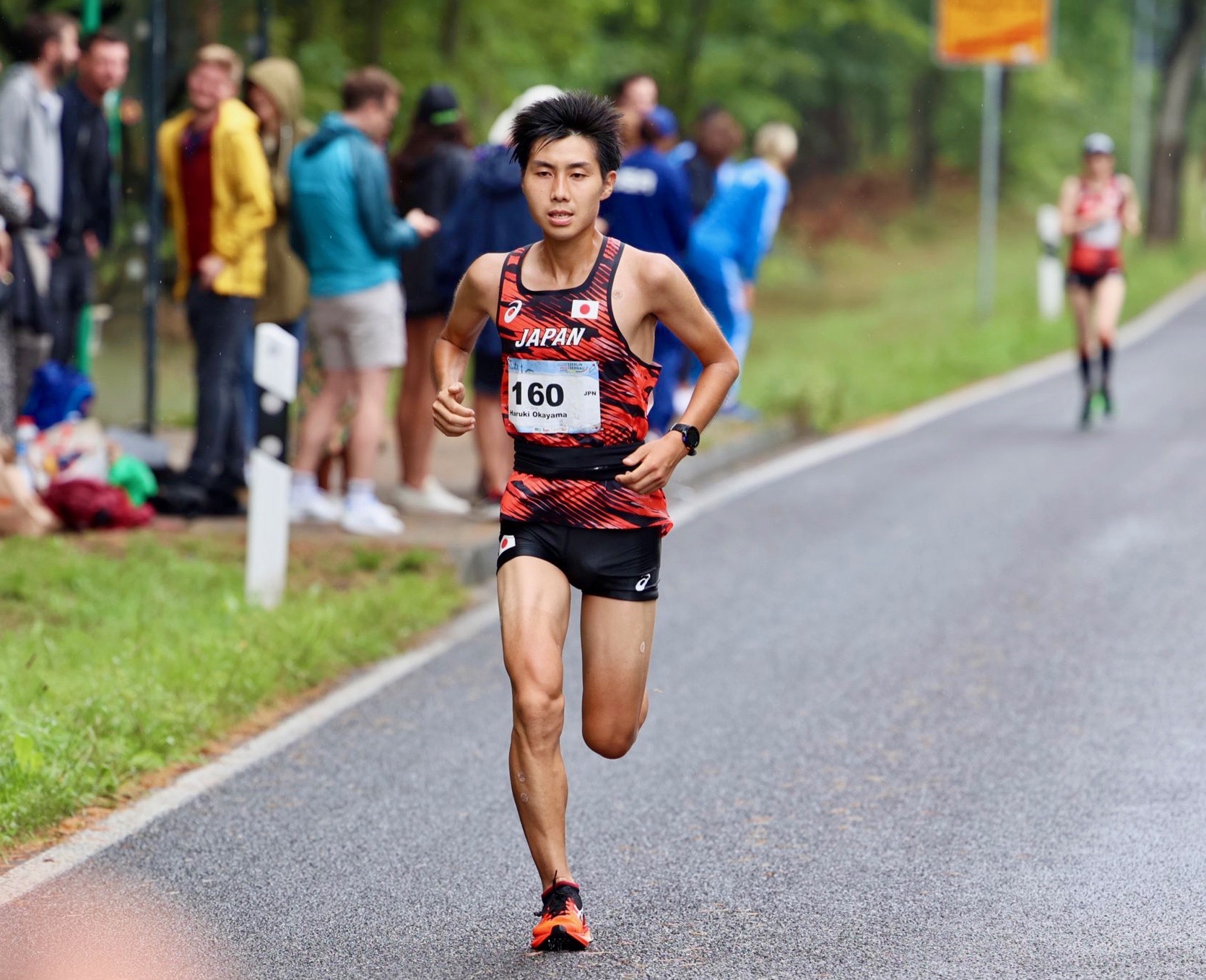
In the world of sports, where ability is everything, there's a man who came all the way from the bottom to stand atop Japan. His name is Haruki Okayama. In 10 years he's gone from being turned away by one of the old school Hakone Ekiden universities teams to representing Japan on its national team. Aug. 27 was the day Okayama wore the national colors for the first time at the IAU 100 km World Championships in Germany. How was he able to make his way along that broken boulevard of dreams, one paved with setback after setback?
Okayama took up running when he was young because of his dad, an enthusiastic amateur runner. He joined his junior high school's track team, and after he ran a very good 15:50 in a 5 km road race he was recruited on scholarship to join the top-tier Chinzei H.S. ekiden team in Kumamoto. That was where things started to go wrong. With a series of injuries, he was mostly unable to run. He only managed to break his 5000 m best the fall of his senior year, running 15:25. But even so, his dream of running the Hakone Ekiden in university was still alive.
"I came from a farming family, so I was interested in Tokyo Nogyo University," he says. "I knew it was somewhere I could both study and compete, and at the time it was a strong team and seemed cool." Specializing in agricultural fields, TNU was one of the old school Hakone powers, having first competed in the 2nd edition and with a total of 69 appearances to date. Its fortunes have fallen on fallow ground lately, but in 2010 it placed 5th at Hakone. To Okayama, still in junior high at the time, it seemed full of scintillating promise. Run Hakone at TNU, then join a local corporate team in Kyushu and go for the Olympics. That was the plan, and the dream.
But his high school achievements as a runner weren't enough to open doors at TNU as an athlete. Undeterred, he took TNU's general entrance exam and passed. A path to walking on to the road to his Hakone dreams seemed to have opened up. Seemed to have. His advisor had told TNU's coach that Okayama wanted to walk on to the team, but when the coach left the university the lines of communication were tangled. And unluckily, he was injured at the start of his first school year and couldn't clear the standards for walking on. He had no choice but to join a school fun running club instead.
A year later he was provisionally accepted to the TNU team on the condition that he break 15:00 for 5000 m by July. Okayama ran with the first-years and used polite language with his fellow second-years as if he really were one of the first-years. But as he trained to clear 15:00, he got injured again. Even so he ran the time trial meet in July as planned, but after he failed to go sub-15 he quit the team in disappointment.
Most people would have given up entirely right there. But Okayama was different. Looking back now, he says, "It was really crushing, but no matter how disappointing it was there was no way around the reality. I turned my mind around and told myself, 'I'm going to be better than the TNU team. It'll be payback, and I'll definitely come out on top.' At that point I always got injured when I trained with a team, so I decided to just do it by myself at my own pace."
In high school Okayama ran 10 km at 4:00/km for morning practice. In university he did at least 10 km in the morning too for mileage, then did serious training after classes. But while this left him injured all the time, the change to his own style worked for him. "I'd read that other people had had success going from doubles to singles," he says, "so I made that change too. When I did, I completely stopped getting injured, my body felt lighter, and it felt like I was really starting to move. I easily broke 15 minutes, and I was as surprised as anyone."
Working around how much time he had in mornings and his class schedule, on a menu of single workouts Okayama grew rapidly. In April his third year of university he ran his first marathon, winning the 2015 Sado Toki Marathon in 2:37:16. His star on the amateur running circuit continued to rise. From October through November that year he ran races 6 weeks in a row including marathons on back-to-back weekends, running 2:25:00 for 2nd at the Tsukuba Marathon and 2:28:20 for 3rd a week later at the Mt. Fuji Marathon.
"'Let's go for the Olympics in the marathon.' That's what I was thinking," he remembers. "Other university guys are doing the half marathon distance at the Hakone Ekiden, so when they go to the marathon it's an advantage in terms of experience. I figured that if you ran a lot of marathons in college you'd have an edge in experience."
Convinced that that was the only way forward for him, his last year of university Okayama won the Saipan Marathon in 2:42:12, the Niigata City Marathon in 2:26:10, and his hometown Kumamoto Castle Marathon in 2:22:45. He was breaking records at local races left right and center. But he wasn't exactly setting land speed records in terms of his job search for after graduation. "I wanted to join a corporate team and keep competing after I graduated," he says. "I tried contacting a lot of teams myself, but it didn't go anywhere at all."
From the point of view of an amateur runner Okayama's times were really good. But on the track and in the half marathon he didn't even come close to being competitive with Hakone Ekiden runners. Not a single team would hire someone who had gone to college but not been part of their school's team. Despite all the work he'd put in and results he'd achieved on his own, there was no way he could keep going the same way. It was a kind of mid-life crisis as an athlete. That can lead to loss of motivation and worse for a lot of people, but here too Okayama found a solution. The area supermarket chain Comodi Iida had an ekiden team. If he couldn't join it as an athlete, he'd get a job there as a regular employee.
The Comodi Iida team was good enough to be targeting the New Year Ekiden. Its roster had a lot of people who'd done Hakone, some top-level track runners, and even Kenyans. Becoming a member would let him focus on being an athlete, but Okayama trained while working full-time. His first assignment was as a clerk in the fruit and vegetables department at Comodi Iida's Asaka branch in Saitama. Since his work hours were from 7:00 to 16:00 every day with a one-hour break the schedule didn't match up with team practice sessions, so a lot of the time he trained alone in the morning before work.
Partly because he had less time to dedicate than he had in college, he struggled to perform in races. That went on for three years, and he said he felt he had hit a limit. Even so, at the Ehime Marathon in February, 2020 he ran a massive PB of 2:14:53, a new Comodi Iida team record. That performance brought him a promotion to full team member, eliminating most of his work responsibilities. "I wasn't really achieving anything, so to be honest I'd been seriously considering quitting the company," he says. "I figured I'd probably be happy just as an amateur runner. The Ehime Marathon was where I was going to give it up, but the way I ran there changed my life."
But the setbacks weren't done setting him back. When his track times didn't really improve, a year later in the spring of 2021 he was demoted to part-time team member, meaning he had to work 6 hours a day. He's currently assigned to a department that oversees direct deliveries from trucks. "My main job is to sign new customers," he says. "I go door-to-door to people's homes, hand out flyers and explain what we do, but most of the time people don't listen. It's really tough work in the summer."
But even though the work is tough, Okayama holds on tight to his dreams. In May this year he took them in a direction he'd wanted to for a long time, making his ultramarathon debut. And hidden talent bloomed. At the 10th running of the Shibamata 100 km from Shibata Park in Tokyo to Goka, Ibaraki, Okayama won in a course record 6:16:47. With the race serving as the selection event for Japan's team for the IAU 100 km World Chamionships, in his first stab at the ultra he found himself on the national team.
"I'd only gone up to 53 km in training, so it was all a new world to me," he says. "Around 70 km it got really hard, and I started getting dizzy and my arms and legs went numb. I was ready to quit, but when I slowed down a little I started to feel OK again and it seemed like I could finish it. I didn't know about the World Championships and I was just lucky that it happened to be the selection race. I still can't believe I made a national team. I'd figured if I ran around 6:40 that would be pretty good, so I was shocked by my time."
Comodi Iida has made the New Year Ekiden the last three years, but Okayama has never been picked for its starting lineup. With his selection to the IAU World Championships team, head coach Yonosuke Aizawa values Okayama's potential. "We've got a 100 km wunderkind on our hands," he says.
On Aug. 27 in Berlin Okayama wore the rising sun for the first time. "I've got the top time in the world this year, so winning's the goal," he says. "I figured if I ran like normal I could do it, but with it being an overseas race there are issues like the food being different, and the main thing is just being on the starting line fully prepared. After this I definitely want to focus on ultras. Next year at Lake Saroma I'll go for the world record, 6:09:14."
In Okayama's time there TNU never made it out of the Hakone Ekiden qualifying race to the big show. Some team members were recruited by corporate teams, but the only one still running competitively now is Okayama. The man who was turned away from a traditional Hakone power is now a World Championships gold medalist. In a year he may even be a world record holder.
"Whatever else, the main thing is to never give up," he says. "That's what I feel. Right when I was ready to walk away, that's when the results came. I was down because the team didn't want me, but I liked doing it and kept at it. If you do that, then good things will happen and new opportunities will open up that you could never have imagined." The early bird may get the worm, but there are other fruit in life that can only be picked by those who keep waiting for them to ripen.
photo © 2022 Tarzan Aqzawa / Eldoreso, all rights reserved
source article:

translated and edited by Brett Larner
Comments