Osaka International Women's Marathon Changes to Hillier New Course

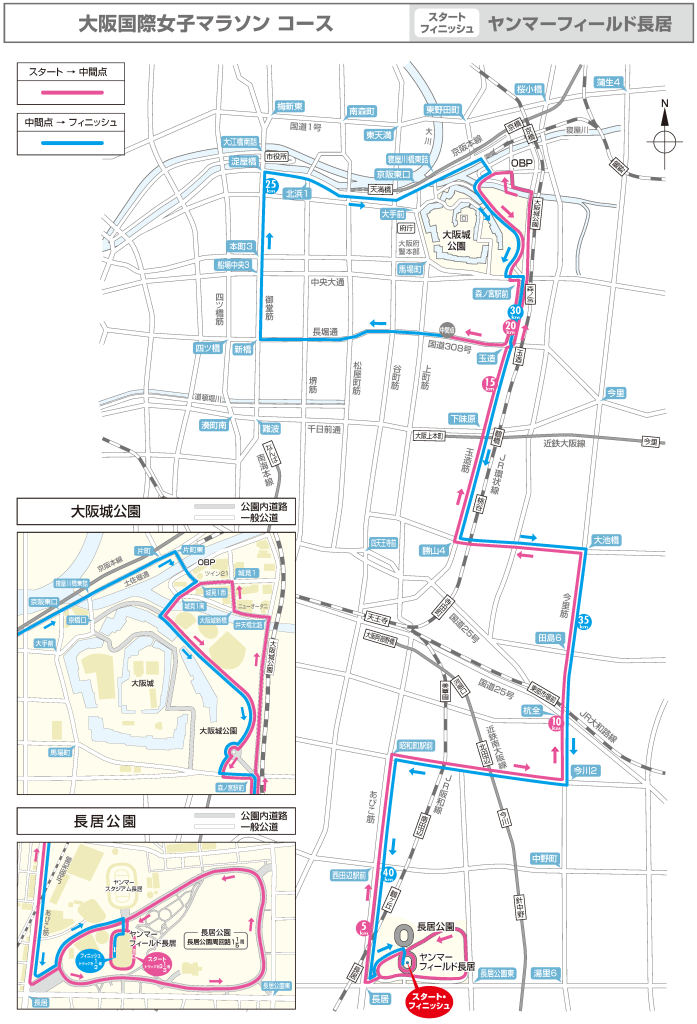
Part of the course for the 42nd Osaka International Women's Marathon to be held on Jan. 29 next year will changed, doubling its maximum elevation difference to 18 m with a hilly new section. 2004 Athens Olympics marathon gold medalist and national record holder Mizuki Noguchi was optimistic about the course change helping to produce fast times, saying, "When there are moderate undulations it's easier to get into a rhythm."

Noguchi had success at the Olympics and elsewhere by attacking on hills. The new section of the Osaka International course on Nagahori-dori after 20 km features a series of uphills and downhills. Noguchi expects the section to play an important part in the race. "People might be thinking of changing the dynamic there, of shaking up the lead group. It's going to be a good thing."

Another key change on the course is the elimination of the turnaround point at Midosuji just before 30 km. "If there's a 180˚ turn you have to slow down, and there's a chance of twisting your ankle," said Noguchi. "There'll be less chance of accidents now." On the new sections of the course spectators will now be able to get closer to the runners. "Their voices will really jump out at the runners," Noguchi said.

It has now been 17 years since Noguchi ran the Japanese national record of 2:19:12. But at last year's Osaka International Women's Marathon Mizuki Matsuda (Daihatsu) ran an event record 2:20:52. Hopes are high that with the course change Osaka will see a Japanese woman run 2:19 on Japanese soil for the first time. "I don't want people just to shoot for sub-2:20. Sub-2:20 is a must," Noguchi said. "These days 2:19 is a given at the international level, and people have to be hitting that kind of time."

source articles:
translated and edited by Brett Larner

Buy Me A Coffee

Comments

Stefan said…
Noguchi's comments ring true. At the very least, if you wish to compete against the world's best then you need to be posting 2:19 (ideally 2:15:37 if you want to win Berlin!). The gap between the World's best vs Japan's best marathoners seems quite large these days. I'm confident this generation of Japanese marathoners will raise their level next year.

Most-Read This Week

Nagoya Asian Games Test Event Canceled After Insulation Falls From Venue Ceiling

A section of insulation material fell from the ceiling of Nagoya Kinjo Futo Arena, the official venue for squash competition at September's Nagoya Asian Games. There were no injuries, but the city suspended use of the arena until its safety could be guaranteed, resulting in the cancelation of the Asian Games squash test event which was scheduled to have begun on May 14. It is not yet clear whether the arena will be usable for the Asian Games as planned. According to city officials, arena staff found that the insulation material had fallen onto a work walkway 13 m above the ground on the night of May 11. The fallen material was 3.6 m long, 50 cm wide and 2.5 km thick, and was found to be waterlogged. The cause of the accident is unknown, but it is possible that it was caused by rainwater leaking in from the roof. The same insulation material is installed across the entire ceiling, and the city plans to check for the extent of the possible flooding. Asked whether the arena will be re...

Hakone Ekiden Qualifying Race Entry Roster Sizes Increased from 14 to 16

Hakone Ekiden organizers KGRR have announced details for the qualifying half marathon for next year's 103rd Hakone Ekiden. The Yosenkai qualifying race will be held Oct. 17 in Tachikawa, Tokyo. The combined times of the 10 fastest finishers from each participating team will be used for team scoring, with the 10 fastest teams going on the the main event next January and top-placing individuals from teams that do not qualify being names to the Kanto Region Student Alliance select team. One change from previous years is that the number of runners each school can enter has been increased from 14 to 16. Teams will still only be allowed to have from 10 to 12 athletes on the starting line, but the move gives coaches greater flexibility in making the final decision on their starting rosters. No changes have been made to the qualifying times of 34:00 for 10000 m or 1:13:00 for the half marathon, and the new earlier starting time of 8:30 a.m. introduced last year in an effort to mitigate ...

Nomura and Odagiri Go 3-4 at Zevenheuvelenloop 15 km

2010 Zevenheuvelenloop 15 km Nijmegen, Netherlands, 11/21/10 Women click here for complete women's results 1. Genet Getaneh (Ethiopia) - 47:53 2. Florence Kiplagat (Kenya) - 48:07 3. Sayo Nomura (Meijo Univ.) - 49:43 4. Aki Odagiri (Meijo Univ.) - 51:37 5. Benita Willis (Australia) - 51:51 Men click here for complete men's results 1. Leonard Patrick Komon (Kenya) - 41:13 - WR 2. Abera Kuma (Ethiopia) - 42:01 3. Ayele Abshiro (Ethiopia) - 42:01 4. Abraham Kiplimo (Uganda) - 43:03 5. Berhanu Delale (Ethiopia) - 43:08 ----- 14. Kazuya Watanabe (Team Sanyo Tokushu Seiko) - 45:31
