Following last week's run over most of the 2020 Tokyo Olympics marathon course exactly two years before the women's marathon, this morning I went out to do it again at the same time the men's marathon will be held. Last week we focused mostly on the first 20 km and finish. This week I looked more at the second part of the course after 20 km, starting at 7 a.m. and making it back to the stadium at 9:45, about the same time the last few runners in the men's race are likely to finish in two years. Effort-wise I ran about 4:15/km, slightly faster than last week's run to get a better sense of what a decent effort would feel like in the Tokyo conditions.
The Report
Last week's heat, humidity and sun pretty well represented Tokyo's weather this summer, but no summer would be complete without a few typhoons. One passed just east of Tokyo yesterday and during the night, bringing cooler temperatures and shifting winds and humidity as it passed to the northeast. The temperature during the run was consistently in the 27˚C to 28˚C range with humidity rising from the low 70% range to nearly 80% as the wind shifted from north to south in the typhoon's wake, briefly ticking over 80% in the moat and canal area just north of the Imperial Palace between 34 and 35 km.The main difference between last week and this week was the cloud cover. Last week's run saw perfectly blue skies that created a major difference between running in shaded areas near tall buildings and more exposed sections of road. The heavy cloud cover today eliminated that as a factor, but without the intense sunlight to focus on the humidity seemed more noticeable this time. Altogether, where last week's conditions were on the high end of normal, today's were on the runner-friendly end of what you can reasonably expect in Tokyo in early August.
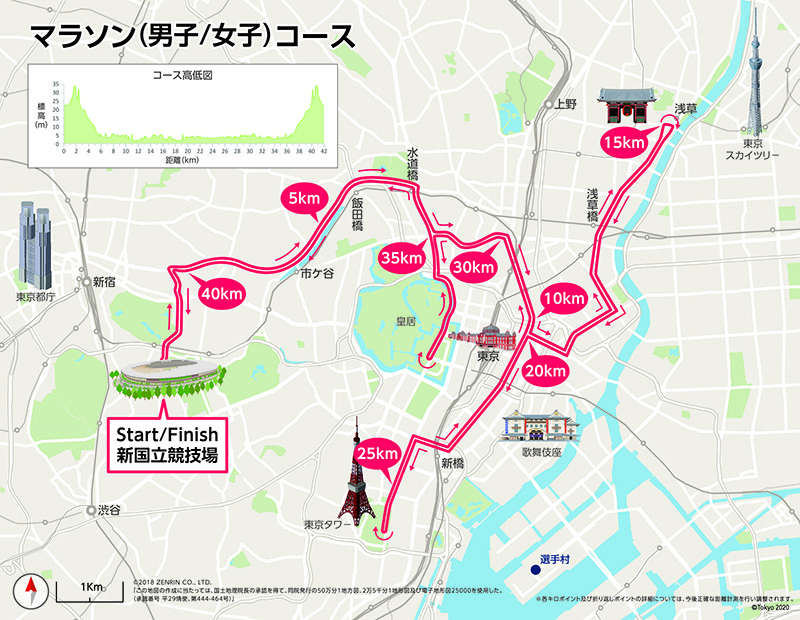
Running the sections that I skipped last week between 20 and 28 km and between 31 and 35 km, it was pretty clear that the course designers are banking on taking advantage of the building shade in Ginza after 20 km. Where the Tokyo Marathon course makes a right at Ginza Crossing at 21 km and then a left onto Hibiya Street, the Olympic course will continue straight on through Ginza Crossing along what's probably the narrowest road on the course before making a right at Shinbashi Station and then the left onto Hibiya Street. This pretty well guarantees better shade coverage both ways than following the Tokyo Marathon route along this section. The turnaround in front of Zojoji Temple and Tokyo Tower is bound to be popular.
The other dogleg from 31 to 35 km is another story. Very craftily positioned, it sets the runners up for a turnaround in front of the Imperial Palace with just under 10 km to go which should set up some exciting racing in the last stage of the race. It's also completely exposed to the sun, so if it's a typically sunny summer day instead of like today it will be potentially the most brutal part of the course. Enough so that Professor Makoto Yokohari, an expert quoted in an NHK report on the potential Tokyo 2020 conditions, called for spectators to be banned from that area because of the higher risk of heat stroke due to the lack of shade. This section is also where the 20 km and 50 km racewalk courses are located, so good luck with that to all Olympic racewalkers, especially if the organizing committee heeds Professor Yokohari's recommendation.
As with last week, the final uphill is nowhere near as bad as it looks on the course map. From 36 to just past 39 km it's not even noticeable. The section just before 40 km is steep but short. Just be sure to save something for the little hill about 500 m after the corner at the top of the main hill, and remember that there's a nice downhill to the stadium waiting after that.
The Outlook
The range of possible conditions runners will have to contend with at the 2020 Tokyo Olympic marathons is fairly clear: pretty hot, humid and cloudy to damn hot, humid and sunny. With a bit of luck there could be a typhoon or heavy rain, but realistically the sunshine is what's going to have the biggest impact. To their credit the course designers have put together a route that tries to minimize the danger to runners from exposure to the sun, mostly running on north-south roads with tall buildings on the eastern side to maximize shade. That might not sound like much, but based on last week's run it makes a major difference. Before doing that run I was completely opposed to a 7:00 a.m. start for the Olympic marathons, but I think now that it's doable.Which is not to say that I think it should be done. All the problems and the solutions organizers are trying to come up with, maximizing access to building shade, installing high-tech pavement, growing trees bigger, would be totally unnecessary with a race after sunset. The health and safety issues aside, the Olympic course, which encapsulates Tokyo's running history from the Hakone Ekiden to the historic Tokyo International Marathon to the modern national record-producing Tokyo Marathon, has been hyped for taking in most of Tokyo's major landmarks. All of them are regularly lit up at night. Tokyo Dome, Nihonbashi, Kaminarimon Gate and Tokyo Skytree in Asakusa, the Ginza shopping boulevard, Zojoji Temple and Tokyo Tower at the 24 km turnaround, the Imperial Palace at the 33 km turn, how unforgettable and iconic would these look in a nighttime marathon? They could even do traditional fireworks along one of the rivers as the runners passed. It feels like a missed opportunity to really show the best of Tokyo to the rest of the world.
There hasn't been substantial discussion that I've seen in the public sphere about why this can't happen, just, "It's starting at 7:00 a.m. so we have to make the best of it." The possible reasons aren't hard to guess, whether it's conflict with evening sessions in other events and closing ceremonies, overseas TV broadcast rights, costs to supplement the already well-lit Tokyo streets, even road closure conflicts with the Tokyo Police, notoriously strict with road closure rights to the point of sometimes putting runners' lives in danger. It's also coincidental that the 75th anniversary of the Nagasaki bombing will be an hour or so after the last few finishers are likely to reach the Olympic Stadium and would have been even closer with the originally planned 7:30 start time for the race.
The inflexibility with the schedule is enough that Japan is looking at introducing daylight saving time for the summer of 2020 rather than change the event schedule. It sounds like a joke, but it's true. Following a request from the Organizing Committee, Prime Minister Abe asked the LDP this week to consider a two-hour daylight saving time shift for the Olympics. The shift to what's now 5:00 a.m. for the start of the marathons would be great news for the athletes in those events, and although there are fears it would lead to longer working hours, from a quality-of-life point of view the prospect of a 6:00 a.m. sunrise and 9:30 p.m. sunset instead of what we have now would be very nice indeed. Of course it would also mean that those in the evening track events and other outdoor sports would get burned, having to compete in the heat of what's now late afternoon instead of the relative cool of evening.
A nighttime marathon seems like the best solution all around, but the IOC has already signed off on the 7:00 a.m. start and that doesn't look likely to change. Based on last week we know the probable worst-case scenario for conditions, and based on having run it in those conditions I now think it's not in the realm of the impossible even if nowhere near putting the athletes' interests first. Train wisely, come visit and do test runs on the course next summer a year out, and race carefully.
© 2018 Brett Larner, all rights reserved

Comments
https://www.youtube.com/watch?v=i_zRr9KOFWE