Today marks two years until the women's marathon at the 2020 Tokyo Olympics. There's been a lot of concern about the 7:00 a.m. start time approved by the IOC two weeks ago as it means that athletes will be running under direct sunlight in temperatures in the low 30's and potentially high humidity. I went down to the Olympic Stadium site this morning and, starting at exactly 7:00 a.m., ran 30 km of the course to check for myself what kind of conditions the athletes will be facing.
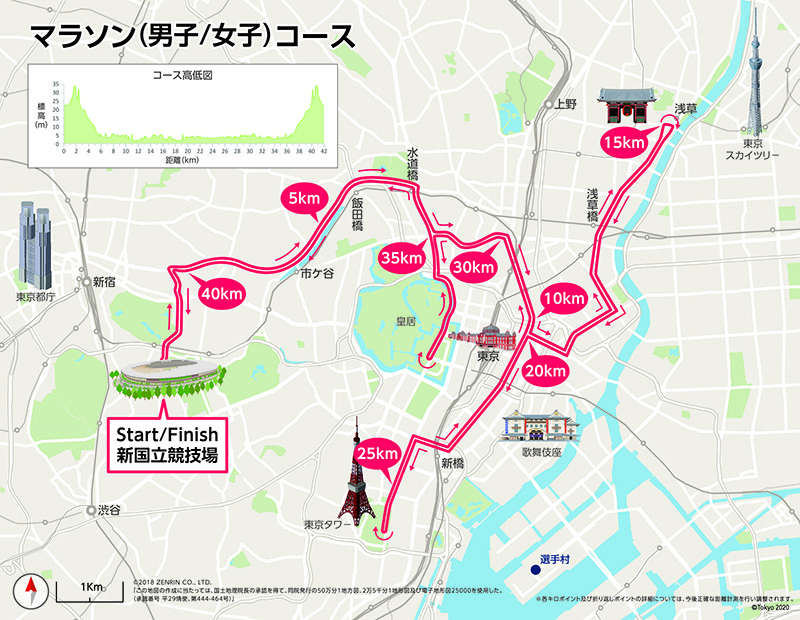
If you're not familiar with Tokyo, take a look at the map to get a better idea of what I'm talking about. I ran from the stadium to the 20 km point and then back, cutting out the sections from 20 to 28 km and from 31 to 35 km which I'll do next week on the 9th, two years ahead of the men's marathon.
The bad news:
The conditions were tough. With zero cloud cover and very little wind, at the time of the 7:00 a.m. start at the Olympic Stadium it was 31.1˚C with 68% humidity according to the thermometer I used during the run. The humidity rapidly rose and leveled off at 88%, while the temperature rose as high as 34.2˚C at 9:30 a.m., roughly the time at which you'd expect the top woman to finish. After 9:30 the temperature rose rapidly. By the time I got back to the stadium at 10:15 it was up to 36.0˚C.These were readings in the shade for the most part; any exposure to direct sunlight and the temperature was much higher. Although I didn't stop to take readings at pavement level, the day before the run at 10:00 a.m. I measured temperatures over 50˚C at ankle height on a road exposed to the sunlight near my apartment walking distance from the Olympic Stadium.
The sections of the course running more or less east-west, especially from the corner labeled 40 km to the one labeled 30 km on the map, were almost entirely exposed to direct sunlight. On the way out runners will be running directly into the sun. On the way back it will be to their left. On much of that section Tokyo is experimenting with a sparkling grey pavement surface that is supposed to reflect solar energy instead of absorbing it. The city is also purportedly growing out the branches on trees along this part of the course to provide more shade.
Whether the pavement is going to be effective remains to be seen, but it looked pretty dubious during this run that the trees are going to provide much more than good PR cover. This means that from about 36 to 40 km runners can expect to be running totally exposed to the sun amid rapidly rising temperatures on the way to the course's only significant uphill.
The good news:
I'm a firm proponent of doing the Tokyo Olympic marathons at night, but evidently there are financial and other reasons for that not to happen. That said, I have to admit the good news: running it in the morning wasn't as bad as I'd expected. I'm a longtime resident of central Tokyo and pretty well acclimated to what has been a very hot summer. I'd planned to run about 5:00/km today, but it was no problem to do the first 10 km at about 4:30/km. From there to 20 km I went closer to 4:15 before backing off to around 4:30 again as it got hotter. Of course that's nowhere near what Olympians will be running but in terms of my own 45-year-old ability it wasn't an issue to run harder than planned without suffering after-effects.Last week I translated an NHK piece where they quoted Professor Makoto Yokohari as saying that it will be key to run in the shade as much as possible. Based on today I'd agree with that assessment. The main reason I was able to run the middle part faster was that it was almost entirely north-south, meaning hard shadows from the buildings on the east side of the road. When there was shade the heat and humidity seemed manageable. On the exposed sections, even just running across broad intersections, it was noticeably harder due to the direct sunlight.
Overall there was more shade than I expected. The first 2 km, the bit from 7 to 7.5 km, the one from 9 to 10 km and the way up to the Asakusa turnaround at 15 km all had good shade coverage to break up the sunnier east-west sections. On the return trip, the sun climbing higher meant a reduction in the shade on the west side of the roads. The section down to the 25 km turnaround should have decent shade coverage while the very craftily-designed 32 km turnaround in front of the Imperial Palace will probably be completely exposed, but I'll check those out next Thursday during the men's marathon time slot.
Other good news: the uphill before 40 km is nowhere near as severe as what it looks like on the elevation profile. Sorry about the sideways video of that part. I'll get better footage next week. The climb from 36 to 39 km isn't even noticeable, and while the main hill right before 40 km is steep it's very short, probably not more than 100 m. It's possible that someone who's not careful might go splat against it but I don't think we're going to see any dramatic turns in fortune there. Watch out for the little hill after the left turn at the top of the main hill, though.
Going forward:
If you're someone who might be running in either Olympic marathon, however early you're planning on getting here come earlier. A lot earlier. Come next summer. The humidity isn't likely to be any higher than it was today, and while the temperature could be higher at worst it probably won't be too much hotter than it was today. You can get used to this kind of weather if you give it time.Prof. Yokohari recommended that organizers route runners as much as possible to the east side of the north-south roads to take advantage of the shade from buildings. I'd definitely second that, but on some sections like the Asakusa leg there will be people running both directions and it won't be possible to run northbound in the eastern lane. Just run as far as they'll let you toward the eastern side so you can take the maximum advantage of what shade there is, especially later in the race when the sun is higher.
Given the heat things will probably go out slowly, but based on today's run I felt that we might see some people take it out faster or really push the middle section after 9 or 10 km. It goes without saying that's a risky strategy, but the part from 31 to 40 km is going to be punishing in the heat and sunlight no matter what, especially after 36 km, and it might be a good idea to take advantage of the relatively cooler and shadier conditions earlier on.
Next Thursday I'll be back at the stadium at 7:00 a.m., the start time of the men's marathon two years from then, to run around 30 km of the course including the two parts I skipped today. More on the course, conditions and my impressions then.
Read JRN's report on running the Olympic course two years out from the men's marathon here.
© 2018 Brett Larner, all rights reserved

Comments
Daytime temps in Tokyo last week and this week: 33 to 38C (91 to 100F). And official temps are measured in the shade, one meter (I think) off the ground. It's MUCH hotter in the sun. At the end of August it could well be hotter. Two years from now, it could be hotter still. And of course, the humidity is the real killer (hopefully not literally). As Brett said, it will be interesting....
Way hotter than Mississippi!